






Contenu

Produits de consommation Industrie
The Practical Guide to Surface Science (2026)

?s=100&d=m
Écrit par
No biography added yet.
Lire la suite
?s=100&d=m
Reviewed by
N/A
No biography added yet.
Lire la suite
?s=100&d=m
Written By

No biography added yet.

?s=100&d=m
Évalué par

N/A N/A

No biography added yet.

Il s’agit d’un guide pratique de la science des surfaces pour les chercheurs travaillant dans l’industrie des produits de consommation.

Dans ce tout nouveau guide, vous apprendrez tout sur :

  • Crucial surface science principles
  • L’importance des mesures scientifiques de surface pour l’industrie des produits de consommation
  • Normes et directives ASTM applicables

Plongeons dans le vif du sujet.

Colorful showcase in cosmetic market

Executive Summary

What it covers: A practical, end-to-end guide to surface science for consumer products; how to measure and interpret contact angle (static + advancing/receding), surface tension (static + dynamic), surface energy, and sliding/roll-off angle to understand real coatings, films, and substrates. It ties the measurements to common product needs like adhesion, cleanability, repellency, durability, and functional coatings.
Key insights: Real-world surfaces show contact angle hysteresis, so advancing/receding angles typically give a more reliable picture than a single static value—especially for assessing cleanliness, roughness, and coating uniformity. Method choice matters (Young–Laplace vs. polynomial fit), dynamic surface tension is critical when interfaces evolve quickly (foams, droplet/bubble formation, drying coatings), and roll-off angle must be interpreted only within a tightly controlled protocol.
Business value: Turns “surface performance” into measurable R&D screens and QC gates; helping teams benchmark treatments, spot contamination/treatment drift early, and reduce iteration time when developing coatings, adhesives, packaging films, and anti-fog/anti-adherent surfaces. Supports practical substitution and sustainability efforts (e.g., PFAS-free and bio-based approaches) by verifying performance under relevant conditions (including sub-zero screening) while improving lot-to-lot consistency.
Standards to follow: Use ISO 19403-7:2024 for tilt-stage roll-off (sliding) angle and (when supported) dynamic advancing/receding angles during motion, with disciplined reporting of liquid, droplet volume, tilt protocol, environment, replicates, and censored outcomes when instrument tilt limits are reached. For the other measurements, align your SOPs with the applicable ISO/ASTM wettability, surface tension, and surface energy methods used in your lab so results are reproducible and comparable across teams and sites.
Bottom line: This is a standards-aware field guide showing what to measure, when to measure it, and how to connect surface metrics to consumer-product performance—backed by benchmark droplet references, practical interpretation guardrails, and real application examples that translate directly into faster development and more defensible QC.

Chapitre 1 : Introduction

Les produits de consommation exploitent diverses propriétés de surface pour obtenir des fonctionnalités spécifiques. Les matériaux d’emballage alimentaire, par exemple, nécessitent une résistance à l’eau, une résistance à la graisse et des propriétés antimicrobiennes pour prolonger la durée de conservation et minimiser les déchets. Pour améliorer la durabilité et la facilité d’entretien des vêtements et des textiles, les tissus sont souvent traités pour leur résistance à l’eau, aux taches et aux plis.

Les ustensiles de cuisine antiadhésifs utilisent des revêtements de surface pour empêcher les aliments de coller, même lorsqu’ils sont cuits sans huile ni beurre. Les lunettes anti-rayures sont recouvertes d’un matériau dur et durable qui résiste aux rayures, prolongeant ainsi leur durée de vie et préservant leur apparence. Les fenêtres bénéficient d’un revêtement en dioxyde de titane qui décompose la saleté et la crasse sous la lumière du soleil, simplifiant ainsi le nettoyage.

Ces exemples montrent comment la manipulation des caractéristiques de surface permet d’obtenir les résultats souhaités sur une large gamme de produits de consommation.

We use the following surface properties to understand the behavior of Consumer Products products and improve their quality.

Chapitre 2 : Mesure de l’angle de contact

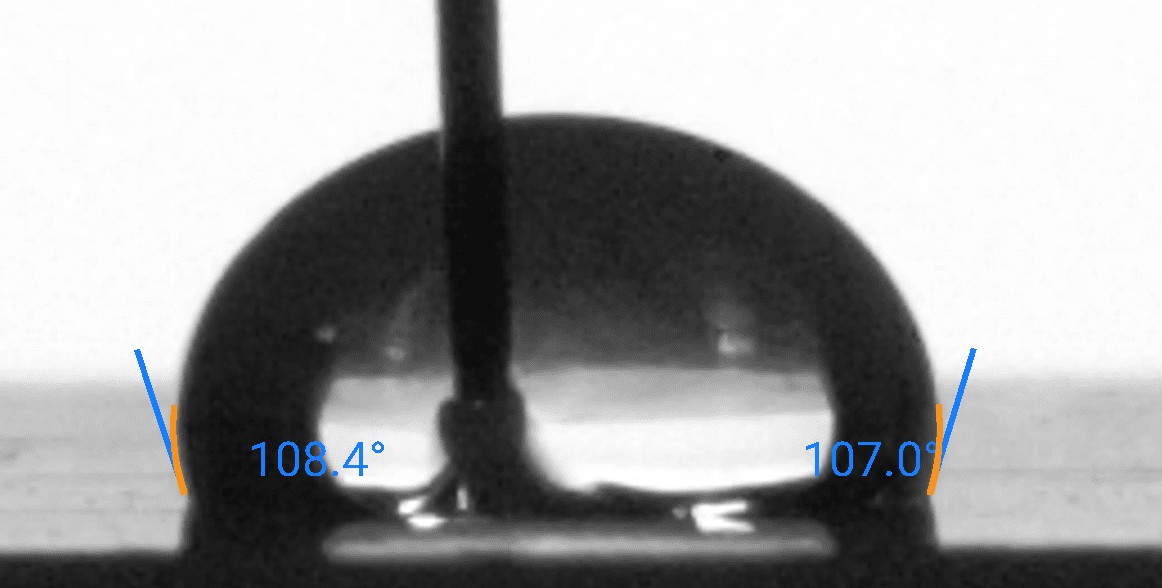
L’angle de contact quantifie la mouillabilité d’une surface en représentant l’angle entre la surface d’un liquide et une surface solide.
Recherche Dropletlab

Sample Image taken from Droplet Lab Tensiometer.

Young – Méthode Laplace

Méthode polynomiale

Angle de contact dynamique

Ideally, when we place a drop on a solid surface, a unique angle exists between the liquid and the solid surface. We can calculate the value of this ideal contact angle (the so-called Young’s contact angle) using Young’s equation. In practice, due to surface geometry, roughness, heterogeneity, contamination, and deformation, the contact angle value on a surface is not necessarily a single consistent value but rather falls within a range. The upper and lower limits of this range are known as the advancing and receding contact angles, respectively. The values of advancing and receding contact angles for a solid surface are highly sensitive to many parameters, such as temperature, humidity, homogeneity, and minor contamination of the surface and liquid. For example, the advancing and receding contact angles of a surface can differ at different locations.

Angle de contact dynamique par rapport à l’angle de contact statique

Les surfaces et les revêtements pratiques présentent naturellement une hystérésis d’angle de contact, indiquant une gamme de valeurs d’équilibre. Lorsque nous mesurons les angles de contact statiques, nous obtenons une seule valeur dans cette plage. S’appuyer uniquement sur des mesures statiques pose des problèmes, tels qu’une mauvaise répétabilité et une évaluation incomplète de la surface en ce qui concerne l’adhérence, la propreté, la rugosité et l’homogénéité.

In practical applications, we need to understand how easily a liquid spreads (advancing angle) and how easily it is removed (receding angle), such as in painting and cleaning. Measuring advancing and receding angles offers a holistic view of liquid-solid interaction, unlike static measurements, which yield an arbitrary value within the range.

Ces informations sont cruciales pour les surfaces du monde réel avec des variations, une rugosité et une dynamique, aidant des industries telles que les cosmétiques, la science des matériaux et la biotechnologie à concevoir des surfaces efficaces et à optimiser les processus.

Découvrez comment la mesure de l’angle de contact est effectuée sur notre tensiomètre

Pour une compréhension plus complète de la mesure de l’angle de contact, lisez notre mesure de l’angle de contact : le guide définitif

Open Benchmark Data: Contact Angle & Surface Energy

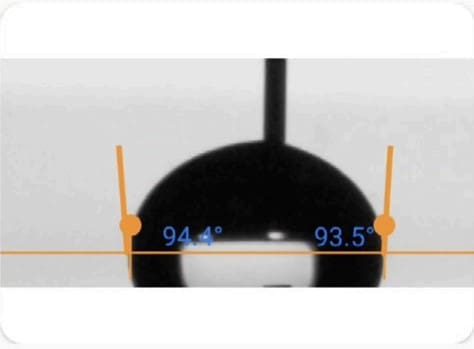
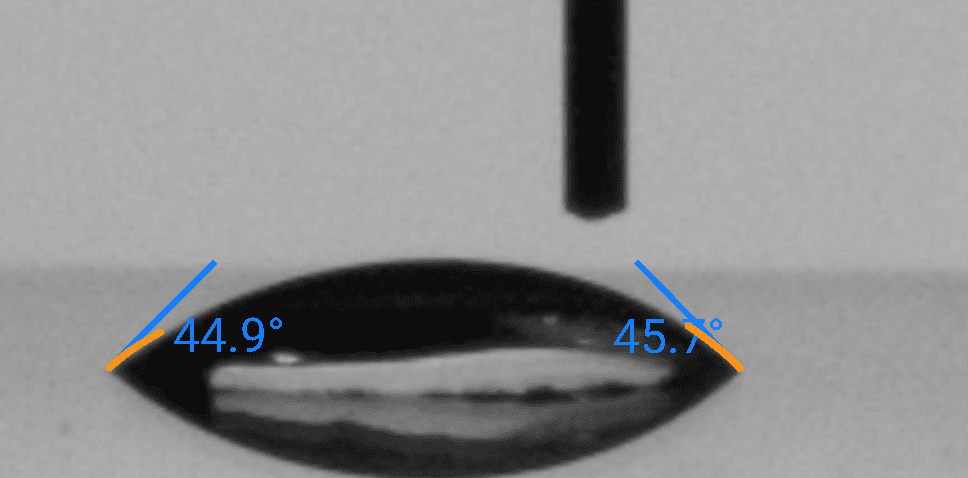
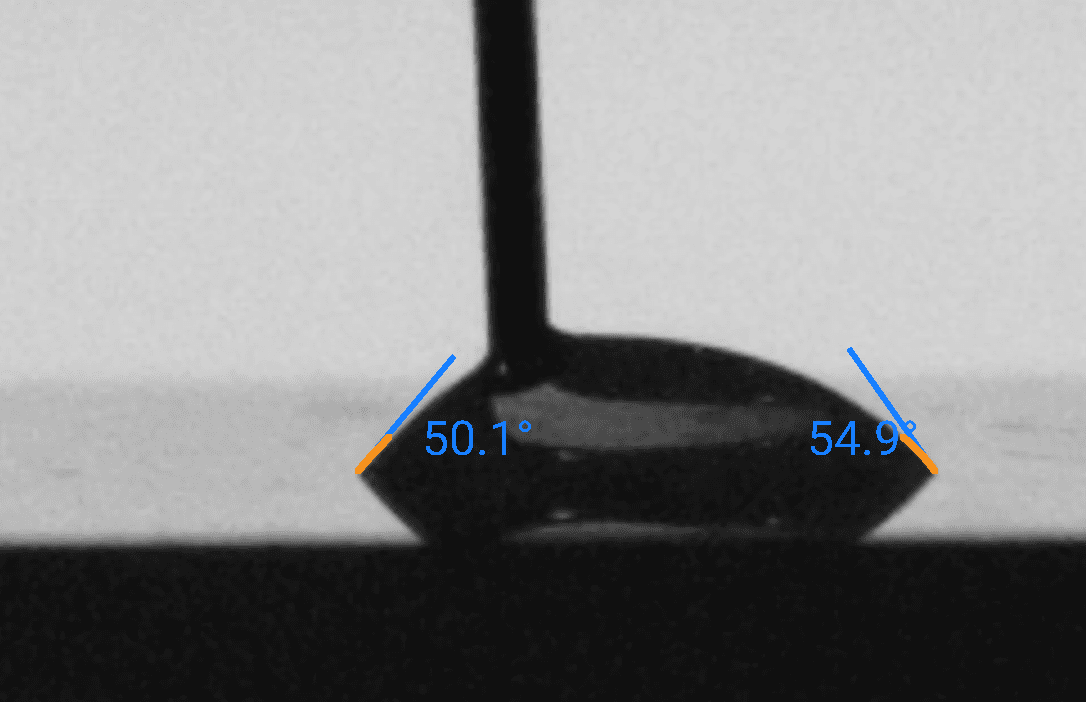
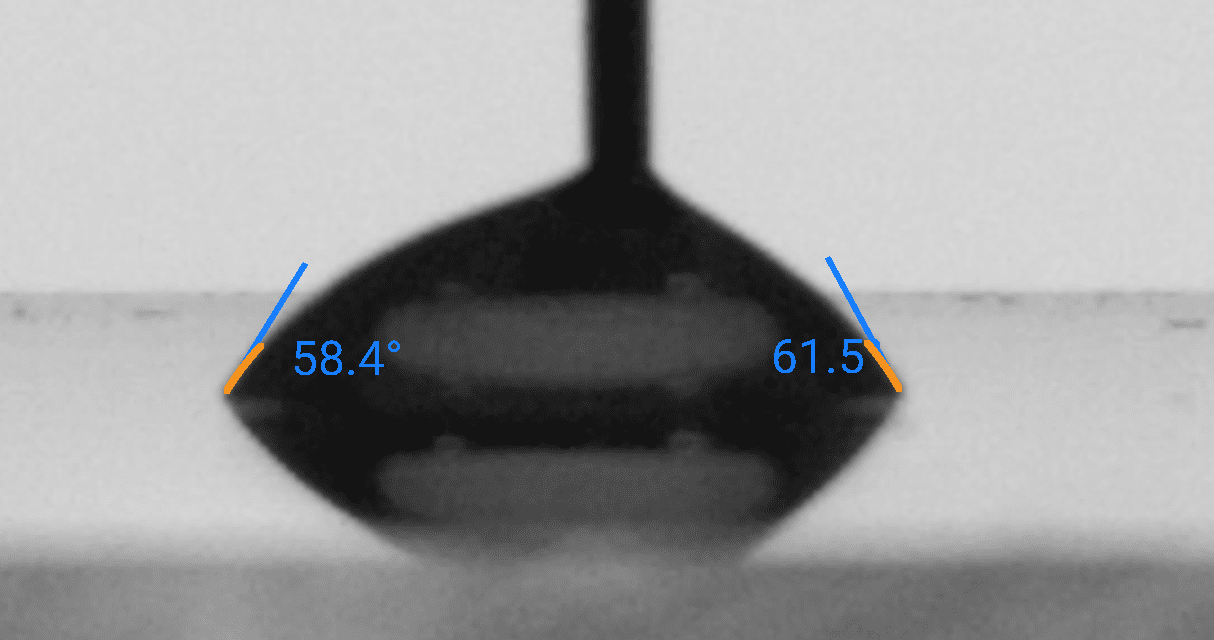
These reference measurements show how deionized water wets four standard substrates measured with the Droplet Lab Dropometer. Use them as visual and numerical benchmarks when you're checking your own sample preparation, treatments, and chemistry.

Full contact angle and surface energy datasets (including additional liquids and statistics) are available on our dataset hub.

Glass - DI Water
Glass - DI Water
Nylon - DI Water
Nylon - DI Water
PMMA - DI Water
PMMA - DI Water
Teflon - DI Water
Teflon - DI Water

The droplet images above are taken from the same benchmark series as our open dataset. For each substrate and probe liquid we report:

● Advancing and receding contact angles (and hysteresis)
● Derived surface energy (SFE) values based on multi-liquid measurements
● Measurement conditions, uncertainties, and sample preparation details

Comparing your own droplet shapes and angles against these references is a fast way to spot contamination, treatment drift, or unexpected changes in wettability.

Chapitre 3 : Mesure de la tension superficielle

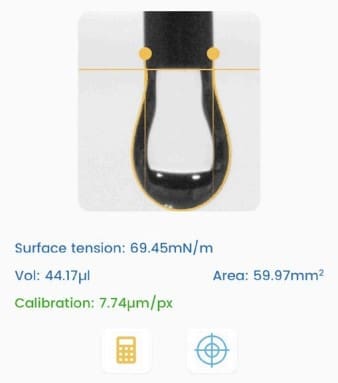
Cette propriété mesure la force qui agit à la surface d’un liquide, dans le but de minimiser sa surface.

Mesure de la tension superficielle

Sample Image taken from Droplet Lab Tensiometer

Tension superficielle dynamique

La tension superficielle dynamique diffère de la tension superficielle statique, qui fait référence à l’énergie de surface par unité de surface (ou à la force agissant par unité de longueur le long du bord d’une surface liquide).

La tension superficielle statique caractérise l’état d’équilibre de l’interface liquide, tandis que la tension superficielle dynamique tient compte de la cinétique des changements à l’interface. Ces changements peuvent impliquer la présence de tensioactifs, d’additifs ou de variations de température, de pression et de composition à l’interface.

Quand utiliser la mesure dynamique de la tension superficielle

Dynamic surface tension is essential for processes that involve rapid changes at the liquid-gas or liquid-liquid interface, such as droplet and bubble formation, coalescence (change in surface area), the behavior of foams, and the drying of paints (change in composition, e.g., evaporation of solvent). It is measured by analyzing the shape of a hanging droplet over time.

La tension superficielle dynamique s’applique à diverses industries, notamment les cosmétiques, les revêtements, les produits pharmaceutiques, la peinture, l’alimentation et les boissons, ainsi que les processus industriels, où la compréhension et le contrôle du comportement des interfaces liquides sont essentiels pour la qualité du produit et l’efficacité des processus.

Apprenez comment la mesure de la tension superficielle est effectuée sur notre tensiomètre

Pour une compréhension plus complète de la mesure de l’énergie de surface, lisez notre mesure de la tension superficielle : le guide définitif

Chapitre 4 : Mesure de l’énergie de surface

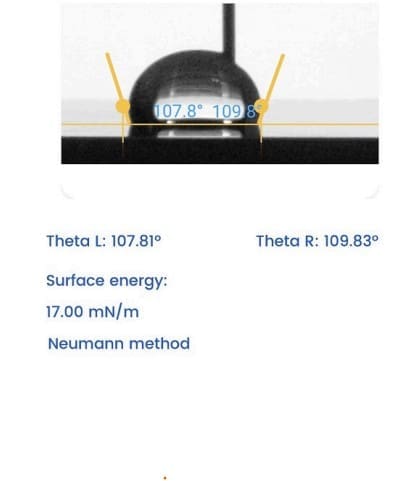
L’énergie de surface fait référence à l’énergie nécessaire pour créer une unité de surface d’une nouvelle surface.
231

Sample Image taken from Droplet Lab Tensiometer

Découvrez comment la mesure de l’énergie de surface est effectuée sur notre tensiomètre

Pour une compréhension plus complète de la mesure de l’énergie de surface, lisez notre mesure de l’énergie de surface : le guide définitif

For benchmark contact angle and surface energy values on glass, nylon, PMMA, and Teflon, see the Open Benchmark Data panel above or visit our Dataset Hub for full CSV downloads.

Chapitre 5 : Mesure de l’angle de glissement

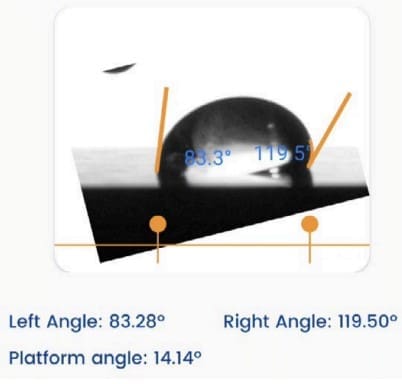
L’angle de glissement mesure l’angle auquel un film liquide glisse sur une surface solide. Il est couramment utilisé pour évaluer la résistance au glissement d’une surface.

Angle de glissement 1

Sample Image taken from Droplet Lab Tensiometer

Apprenez comment la mesure de l’angle de glissement est effectuée sur notre tensiomètre

Pour une compréhension plus complète de la mesure de l’angle de glissement, lisez notre Mesure de l’angle de glissement : le guide définitif

Chapitre 6 : Applications dans le monde réel

Dans l’industrie des produits de consommation, plusieurs études de cas illustrent les avantages de la réalisation de mesures de propriétés de surface.

Designing PFAS-free, bio-based performance waxes for consumer sporting goods using sub-zero contact angle screening

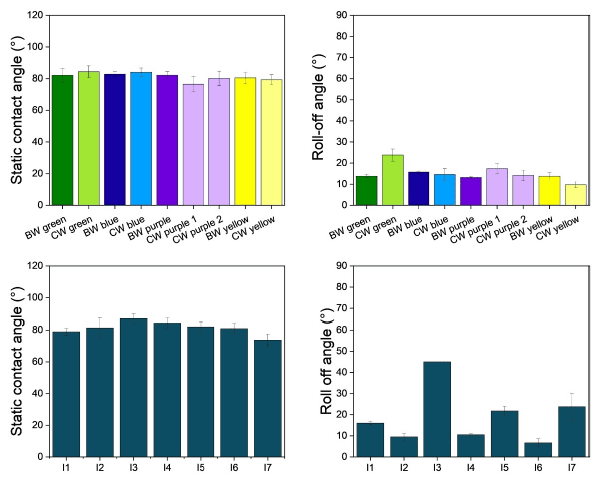
This report describes the development of bio-based prototype ski waxes and their benchmarking against commercial PFAS-free, petroleum-based ski waxes, with emphasis on hydrophobicity, glide performance on snow, biodegradation, and hardness. The prototypes were formulated from bio-derived ingredients selected to be acceptable for topical application or ingestion, and adjusted based on melting points, hydrophobic tendencies, and learnings from earlier prototype testing. The guiding hypothesis was that greater water repellency could improve glide by helping remove the thin water film formed at the ski–snow interface. Hydrophobicity was quantified using contact angle measurements (water and ethylene glycol) at controlled room conditions, and additionally at sub-zero temperature (−5 °C) using a portable setup. Across wax formulations, static, advancing, and receding contact angles were broadly similar between bio-based prototypes and commercial comparators at both temperatures; however, commercial waxes showed slightly lower roll-off behavior with water at room conditions, while ingredient-level testing produced larger differences than finished wax comparisons. On-snow glide testing with multiple skiers did not clearly separate bio-based from commercial wax performance, indicating comparable glide under the tested conditions. The report also compared biodegradation using a compost respiration approach, finding the tested bio-based wax degraded more quickly than the commercial wax under the study assumptions. Hardness testing at −5 °C showed several commercial waxes were harder than their bio-based counterparts, with one exception where the bio-based “yellow” wax was harder than the corresponding commercial wax. The report concludes that the bio-based prototypes are competitive with conventional PFAS-free products while offering advantages in renewability and biodegradation, and notes future opportunities such as optimizing ingredient ratios, adding bio-based performance additives, and developing a liquid-format wax.

Role of the Droplet Lab Goniometer

A portable Droplet Lab contact angle instrument (tensiometer) was rented and placed in a freezer room at −5 °C specifically to enable sub-zero contact angle measurements when attempts to cool the lab-based setup faced practical issues (e.g., condensation and temperature mismatch between droplet and surface). Using ethylene glycol as the probe liquid (lower freezing point than water), the Droplet Lab system enabled evaluation of static contact angle and approximate roll-off behavior under winter-relevant conditions, supporting realistic screening of wax hydrophobicity for cold-weather consumer performance products.

Key Findings

  • All tested waxes were hydrophobic in room-temperature water testing (static contact angles >90°), and bio-based prototypes matched commercial waxes closely in static and dynamic (advancing/receding) angles.
  • Roll-off (sliding) angles with water at room temperature were slightly lower for commercial waxes versus corresponding bio-based prototypes, indicating marginally easier droplet shedding in that condition.
  • Ethylene glycol produced lower contact angles than water on the same wax surfaces and behaved differently, highlighting that probe-liquid choice can change apparent “hydrophobicity” ranking.
  • Using the Droplet Lab portable system at −5 °C (ethylene glycol), waxes still showed similar static contact angles, and roll-off differences were smaller (with added variability due to manual tilting).
  • On-snow glide performance was not significantly different across the tested waxes; bio-based prototypes were comparable to commercial PFAS-free products in the field test.
  • In compost respiration testing, the bio-based wax showed faster estimated complete degradation (reported estimate: 223 days vs 335 days for the commercial wax, under stated assumptions).

Why It Matters

For consumer performance products like ski wax, brands must balance glide performance, usability, and increasingly sustainability/chemical stewardship (e.g., PFAS-free positioning and renewable content). This study demonstrates a practical development pathway where contact angle + roll-off angle metrics can be used as formulation screens to guide ingredient selection and prototype iteration, while sub-zero testing with a portable goniometer helps validate that water-repellency behavior persists near real-use temperatures. The outcome—bio-based waxes performing comparably to established commercial products—supports decision-making around material substitution, eco-claims with performance parity, and potential quality specifications (e.g., minimum static angle / maximum roll-off angle thresholds) for batch-to-batch control.

Method Snapshot

  • Sample: Wax films prepared by melting a ski-wax layer onto microscope glass (wax iron).
  • Droplet/conditions: Room temperature measurements used 25 µL droplets and a tilt rate of 0.30°/s to obtain static/advancing/receding angles plus roll-off; sub-zero measurements used ethylene glycol at −5 °C with 4–5 droplets per sample using the portable Droplet Lab device.
  • Surface tension reference: Probe liquid surface tensions were listed (e.g., water 72.8 mN/m, ethylene glycol 47.7 mN/m) in Table 1.

Data Note

Figure reports the static contact angles and approximate roll-off angles at −5 °C obtained using the portable Droplet Lab contact angle instrument in the freezer room. (Instrument shown in Figure 3.)

Figure

Citation (APA Format)

Skedung, L., & Almgren Stenberg, E. (2024). Bio-based ski wax: Prototype development, hydrophobicity, hardness, biodegradation and glide performance on snow (RISE Report 2024:53). RISE Research Institutes of Sweden AB.

View Publication →

Adhésif à base d’eau

La fluctuation des prix du pétrole représentait un défi majeur pour les fabricants qui dépendaient des adhésifs à base de pétrole. Cela les a forcés à chercher des solutions alternatives. Les chercheurs ont identifié l’adhésif à base d’eau au latex de caoutchouc naturel (NRL) comme une alternative prometteuse. Pour s’assurer de sa mise en œuvre réussie, ils ont étudié les forces de décollement et de maintien de différents supports en papier sur des substrats en acier inoxydable et en verre. Grâce à des expériences d’énergie de surface et d’angle de contact sur différents papiers de support, ils ont découvert que le papier mahjong avait l’énergie de surface la plus élevée (59,50 mN/m), ce qui en fait un substrat idéal pour un mouillage optimal de l’adhésif.

Adhésif à base d’eau

Affinité du produit avec le matériau d’emballage

Défi: Les produits alimentaires collés à leur emballage peuvent augmenter le risque que des composés nocifs de l’emballage migrent dans les aliments ou que des mauvais goûts indésirables soient absorbés.

Solution: Les chercheurs ont identifié que pour résoudre ce problème, les films d’emballage doivent être à la fois hydrophobes (hydrofuges) et avoir une faible énergie de surface. Cependant, le même film doit également bien adhérer à la couche extérieure de l’emballage. Par conséquent, pour améliorer l’adhérence aux autres couches de plastique, ils ont décidé d’augmenter l’énergie de surface du film d’emballage. Ils ont utilisé le traitement des décharges corona (CDT) largement utilisé à cette fin. Pour évaluer le niveau d’adhérence atteint, l’équipe de R&D a mesuré l’angle de contact du film traité, ce qui permet de déterminer de combien l’énergie de surface a augmenté en introduisant des groupes polaires à la surface.

Affinité du produit avec le matériau d’emballage

Problèmes de buée sur les lunettes de sport

An eyewear company faced a fogging problem with their sports goggles, hindering athletes' visibility during activities. To combat this, they actively developed hydrophobic coatings using contact angle measurements. Their aim was to achieve an optimal angle that minimized water adhesion, the key factor in fog formation. By minimizing adhesion, they successfully created anti-fog eyewear, significantly improving user experience across various sports.

Problèmes de buée sur les lunettes de sport

Le polydiméthylsiloxane (PDMS) mouillant par l’eau

Le PDMS, bien qu’hydrophobe, absorbe étonnamment jusqu’à ~30 mM d’eau au contact. Les chercheurs ont relevé ce défi en mesurant les angles de contact ascendants et reculés des gouttelettes d’eau sur des PDMS réticulés. Ils ont découvert que le PDMS s’adapte à l’eau en enrichissant l’interface avec des oligomères libres, entraînant une diminution nette de la tension superficielle. Ces informations cruciales nous aident à développer des stratégies pour minimiser l’affinité avec l’eau et améliorer les performances des matériaux PDMS.

Le polydiméthylsiloxane (PDMS) mouillant par l’eau

Amélioration de l’adhérence dans les protecteurs d’écran d’appareils mobiles

To address the challenge of poor adhesion, the screen protector manufacturer's technical team actively measured the surface energy of different materials. This allowed them to select materials with compatible surface energies, ensuring strong adhesion between the screen and the protector. This proactive approach significantly enhanced the reliability of their screen protectors, directly meeting consumer expectations for durable and long-lasting device protection.

Amélioration de l’adhérence dans les protecteurs d’écran d’appareils mobiles

Nous sommes vos partenaires dans la résolution de votre activité et de votre Défis

Si vous êtes intéressé par la mise en œuvre de ces applications ou de toute autre application, veuillez nous contacter.

Chapitre 7 : Normes et lignes directrices

In an industry where precision reigns supreme, how can Consumer Products manufacturers ensure their products withstand scrutiny? The answer lies in standards and guidelines: the compass that guides them through the complex maze of quality and performance.

ISO 19403-7:2024 — Contact Angle on a Tilt Stage (Roll-Off / Sliding Angle)

What it is

International standard method for determining the roll-off (sliding) angle, α—defined as the tilt angle at which a droplet just begins to move on a solid surface using a tilt stage. It also defines how to determine dynamic advancing and receding contact angles (θₐ/θᵣ) during roll-off to evaluate easy-to-clean / anti-adherent surfaces.

When to use it

Easy-to-clean / anti-adherent screening & benchmarking

Use when you need a quantitative droplet-mobility metric (α, and optionally θₐ/θᵣ) to compare coatings, treatments, or materials under a controlled droplet/tilt protocol.

QC mobility gate (lot-to-lot / process control)

Use when you want a repeatable acceptance criterion tied to droplet shedding (e.g., “α must be ≤ X°”) and monitored using replicates and a reference (“golden”) panel.

In-scope / Out-of-scope

In scope
  • Roll-off/sliding angle measurement on a tilt stage under a defined liquid, droplet volume, and tilt procedure (rate or step/dwell).
  • Optional dynamic θₐ/θᵣ during motion at (or immediately after) the onset of droplet movement, when your capture/analysis supports front/rear angle extraction.
  • Coated and treated surfaces where droplet mobility matters, including coated panels, plastics, glass, and films.
  • Replicate, multi-spot measurements intended to capture heterogeneity/defects and support robust reporting (e.g., median + IQR).
Out of scope
  • Static contact angle-only characterization (use a static CA method/standard if that’s the objective).
  • Direct surface energy or liquid surface tension measurement (requires other test methods).
  • Uncalibrated “self-cleaning” or performance claims without correlation to functional outcomes (cleanability/release tests).
  • Angles beyond the mechanical capability of the tilt stage (e.g., if the stage is limited to 0°–60°, true α > 60° cannot be directly measured).

Minimum you must report (checklist)

  • Test liquid (identity and preparation) and droplet volume.
  • Tilt protocol (tilt rate or step size, dwell time, starting angle, and maximum tilt achievable).
  • Specimen description (material/coating system, finish/texture, treatment history, and cleaning/handling method).
  • Environmental conditions (temperature, relative humidity, conditioning time if used).
  • Roll-off result: α (degrees) if roll-off occurs within range, or a censored outcome such as “No roll-off observed by X° (instrument limit)”.
  • Replicates & sampling plan (number of spots/locations) plus summary statistic (e.g., median) and spread (IQR or SD).
  • Validity/exclusion criteria (e.g., non-axisymmetric drop, baseline/edge-fit failure, visible contamination, vibration/tilt instability).
  • If reported: θₐ/θᵣ during motion (how front/rear angles were extracted and at what moment/frame relative to onset of motion).

Note: Roll-off angle is highly sensitive to droplet volume, liquid, and tilt rate/step rules, so these must be locked in an SOP for meaningful comparisons. If your instrument’s tilt range is capped (e.g., 0°–60°), surfaces requiring >60° must be reported as out-of-range (e.g., “α ≥ 60° / no roll-off observed”) rather than as a true ISO roll-off value.

How to interpret results (guardrails)

  • Lower α generally indicates easier shedding for that liquid and protocol, but do not compare α across different droplet volumes, liquids, or tilt procedures.
  • High static contact angle ≠ good mobility: strong pinning/hysteresis can yield high α or no roll-off within the instrument limit (including “sticky” regimes).
  • Treat “no roll-off by X°” as a censored measurement, suitable for screening/QC trending but not a substitute for an actual α if your spec requires values above X°.
  • Set pass/fail thresholds by correlation, linking α (and variability across spots) to functional outcomes (cleanability, release, anti-adhesion) and tracking drift with a reference panel.

Maintenant, c’est à votre tour

We hope this guide showed you how to apply surface science in the Consumer Products industry.

Maintenant, nous aimerions vous céder la parole :

Feel free to leave a comment below—we’d love to hear from you.

Laisser une réponse

Votre adresse e-mail ne sera pas publiée. Les champs obligatoires sont marqués *


Télécharger l’expérience