



Contenu

Cosmétique Industrie
The Practical Guide to Surface Science (2026)

D54c15105cfe94f786c500e4091d6ea65457608fde49ba183c8f862814a54249?s=100&d=m
Écrit par
Dr Amit Pratap Singh
PhD, Delhi University Post Doc - AIST Japan
Guest Author
Lire la suite
Alité
Reviewed by
Dr Alidad Amirfazli
Dr. Amirfazli, a leading expert in surface wetting and superhydrophobic coatings, has 250+ publications, edits Advances in Colloid and Interface Science, and has received multiple research awards.
Scientific Advisor & Co-founder
Lire la suite
D54c15105cfe94f786c500e4091d6ea65457608fde49ba183c8f862814a54249?s=100&d=m
Written By

Dr Amit Pratap Singh

Guest Author

PhD, Delhi University

Post Doc - AIST Japan

Alité
Évalué par

Dr Alidad Amirfazli

Scientific Advisor & Co-founder

Dr. Amirfazli, a leading expert in surface wetting and superhydrophobic coatings, has 250+ publications, edits Advances in Colloid and Interface Science, and has received multiple research awards.

This is a practical guide to Surface Science for researchers working in the Cosmetics Industry.

Dans ce tout nouveau guide, vous apprendrez tout sur :

  • Crucial surface science principles
  • The significance of surface science measurements for the Cosmetics industry
  • Normes et directives ASTM applicables

Plongeons dans le vif du sujet.

Cosmétique

Executive Summary

What it covers: How cosmetics and personal care teams use four measurements: surface and interfacial tension, contact angle, surface free energy and sliding angle. Each one is tied to a real product problem, such as emulsion stability, water resistance or PFAS free reformulation.
Key insights: Interfacial tension screens emulsifiers before long stability trials, but a low value alone does not make an emulsion stable. A Harvard thesis that measured interfacial tension on a Droplet Lab instrument found lasting stability only when two additives worked together at the interface. Contact angle turns water resistance and repellency into numbers you can compare.
Business value: Surface measurements catch drift in surfactants, emulsifiers and raw materials before a batch fails a stability or claim test. One portable kit covers all four measurements, so a formulation lab can screen candidates at the bench without booking a shared benchtop instrument.
Standards to follow: ASTM D1331 describes surface and interfacial tension of solutions by ring and plate force tensiometry. ISO 4311 describes finding the critical micelle concentration of surfactants from surface tension across a dilution series. The Dropometer uses the pendant drop method, so build a correlation on your own samples before you compare results with either standard.
Bottom line: Measure surface and interfacial tension while you formulate, and contact angle once the product sits on skin, hair or a substitute surface. Start with the measurement that matches your failure, then book a 15-minute consult about testing it on your own samples.

Chapitre 1 : Introduction

In cosmetics, many product failures start at an interface. An emulsion that creams or separates on the shelf fails the customer, even when every ingredient passed release. A sunscreen or mascara that lets water through loses its long wear claim.

These are the places where wetting decides yield in cosmetics work:

The Dropometer drop shape analysis kit measures contact angle, surface and interfacial tension, surface free energy and sliding angle with one portable setup. Its method was validated against a KRUSS DSA100E in two peer reviewed papers. If you are new to the terms, start with wettability.

We use the following surface properties to understand the behavior of Cosmetics products and improve their quality.

Chapitre 2 : Mesure de l’angle de contact

L’angle de contact quantifie la mouillabilité d’une surface en représentant l’angle entre la surface d’un liquide et une surface solide.
Recherche Dropletlab

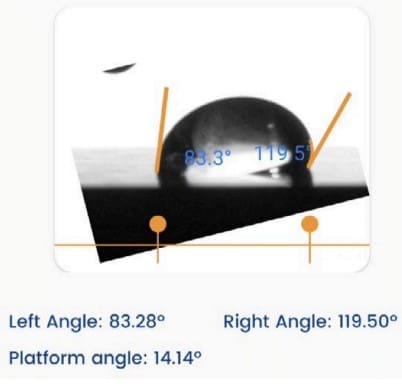
Sample Image taken from Droplet Lab Tensiometer.

Young – Méthode Laplace

Méthode polynomiale

Angle de contact dynamique

Ideally, when we place a drop on a solid surface, a unique angle exists between the liquid and the solid surface. We can calculate the value of this ideal contact angle (the so-called Young’s contact angle) using Young’s equation. In practice, due to surface geometry, roughness, heterogeneity, contamination, and deformation, the contact angle value on a surface is not necessarily a single consistent value but rather falls within a range. The upper and lower limits of this range are known as the advancing and receding contact angles, respectively. The values of advancing and receding contact angles for a solid surface are highly sensitive to many parameters, such as temperature, humidity, homogeneity, and minor contamination of the surface and liquid. For example, the advancing and receding contact angles of a surface can differ at different locations.

Angle de contact dynamique par rapport à l’angle de contact statique

Les surfaces et les revêtements pratiques présentent naturellement une hystérésis d’angle de contact, indiquant une gamme de valeurs d’équilibre. Lorsque nous mesurons les angles de contact statiques, nous obtenons une seule valeur dans cette plage. S’appuyer uniquement sur des mesures statiques pose des problèmes, tels qu’une mauvaise répétabilité et une évaluation incomplète de la surface en ce qui concerne l’adhérence, la propreté, la rugosité et l’homogénéité.

In practical applications, we need to understand how easily a liquid spreads (advancing angle) and how easily it is removed (receding angle), such as in painting and cleaning. Measuring advancing and receding angles offers a holistic view of liquid-solid interaction, unlike static measurements, which yield an arbitrary value within the range.

Ces informations sont cruciales pour les surfaces du monde réel avec des variations, une rugosité et une dynamique, aidant des industries telles que les cosmétiques, la science des matériaux et la biotechnologie à concevoir des surfaces efficaces et à optimiser les processus.

Découvrez comment la mesure de l’angle de contact est effectuée sur notre tensiomètre

Pour une compréhension plus complète de la mesure de l’angle de contact, lisez notre mesure de l’angle de contact : le guide définitif

Open Benchmark Data: Contact Angle & Surface Energy

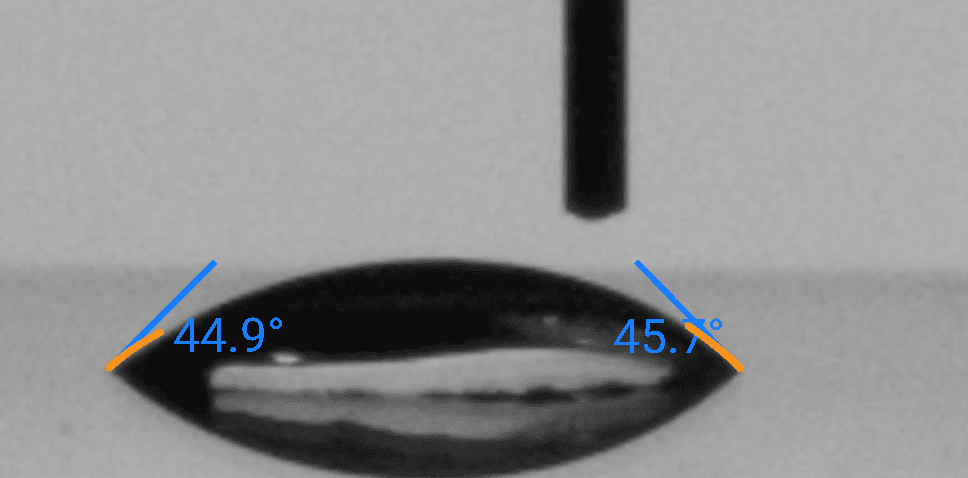
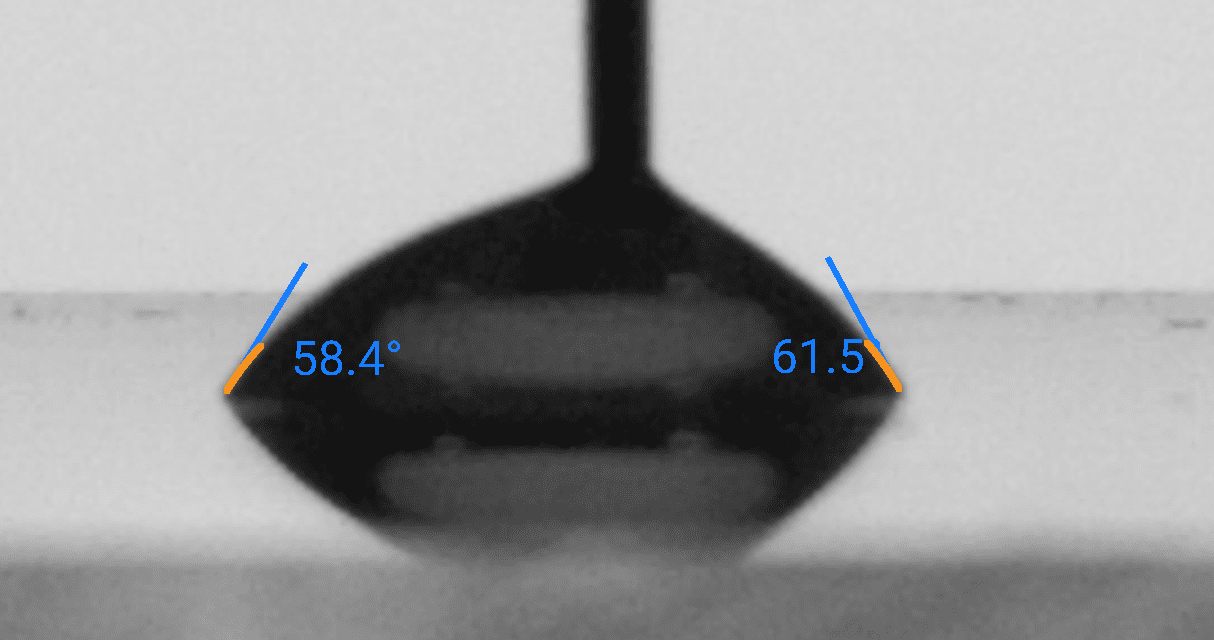
These reference measurements show how deionized water wets four standard substrates measured with the Droplet Lab Dropometer. Use them as visual and numerical benchmarks when you're checking your own sample preparation, treatments, and chemistry.

Full contact angle and surface energy datasets (including additional liquids and statistics) are available on our dataset hub.

Glass - DI Water
Glass - DI Water
Nylon - DI Water
Nylon - DI Water
PMMA - DI Water
PMMA - DI Water
Teflon - DI Water
Teflon - DI Water

The droplet images above are taken from the same benchmark series as our open dataset. For each substrate and probe liquid we report:

● Advancing and receding contact angles (and hysteresis)
● Derived surface energy (SFE) values based on multi-liquid measurements
● Measurement conditions, uncertainties, and sample preparation details

Comparing your own droplet shapes and angles against these references is a fast way to spot contamination, treatment drift, or unexpected changes in wettability.

Chapitre 3 : Mesure de la tension superficielle

Cette propriété mesure la force qui agit à la surface d’un liquide, dans le but de minimiser sa surface.

Mesure de la tension superficielle

Sample Image taken from Droplet Lab Tensiometer

Tension superficielle dynamique

La tension superficielle dynamique diffère de la tension superficielle statique, qui fait référence à l’énergie de surface par unité de surface (ou à la force agissant par unité de longueur le long du bord d’une surface liquide).

La tension superficielle statique caractérise l’état d’équilibre de l’interface liquide, tandis que la tension superficielle dynamique tient compte de la cinétique des changements à l’interface. Ces changements peuvent impliquer la présence de tensioactifs, d’additifs ou de variations de température, de pression et de composition à l’interface.

Quand utiliser la mesure dynamique de la tension superficielle

Dynamic surface tension is essential for processes that involve rapid changes at the liquid-gas or liquid-liquid interface, such as droplet and bubble formation, coalescence (change in surface area), the behavior of foams, and the drying of paints (change in composition, e.g., evaporation of solvent). It is measured by analyzing the shape of a hanging droplet over time.

La tension superficielle dynamique s’applique à diverses industries, notamment les cosmétiques, les revêtements, les produits pharmaceutiques, la peinture, l’alimentation et les boissons, ainsi que les processus industriels, où la compréhension et le contrôle du comportement des interfaces liquides sont essentiels pour la qualité du produit et l’efficacité des processus.

Apprenez comment la mesure de la tension superficielle est effectuée sur notre tensiomètre

Pour une compréhension plus complète de la mesure de l’énergie de surface, lisez notre mesure de la tension superficielle : le guide définitif

Chapitre 4 : Mesure de l’énergie de surface

L’énergie de surface fait référence à l’énergie nécessaire pour créer une unité de surface d’une nouvelle surface.
231

Sample Image taken from Droplet Lab Tensiometer

Découvrez comment la mesure de l’énergie de surface est effectuée sur notre tensiomètre

Pour une compréhension plus complète de la mesure de l’énergie de surface, lisez notre mesure de l’énergie de surface : le guide définitif

For benchmark contact angle and surface energy values on glass, nylon, PMMA, and Teflon, see the Open Benchmark Data panel above or visit our Dataset Hub for full CSV downloads.

Chapitre 5 : Mesure de l’angle de glissement

L’angle de glissement mesure l’angle auquel un film liquide glisse sur une surface solide. Il est couramment utilisé pour évaluer la résistance au glissement d’une surface.

Angle de glissement 1

Sample Image taken from Droplet Lab Tensiometer

Apprenez comment la mesure de l’angle de glissement est effectuée sur notre tensiomètre

Pour une compréhension plus complète de la mesure de l’angle de glissement, lisez notre Mesure de l’angle de glissement : le guide définitif

Chapitre 6 : Applications dans le monde réel

Within the Cosmetics industry, several case studies exemplify the advantages of conducting surface property measurements.

Influence of Cellulose Nanocrystals and Surfactants on Catastrophic Phase Inversion and Stability of Emulsions

This study presents the first quantitative comparison of catastrophic phase inversion behavior of water-in-oil emulsions stabilized by nanocrystalline cellulose (NCC) and molecular surfactants with different headgroup charge types: anionic (sodium dodecyl sulfate referred to as SDS), cationic (octadecyltrimethylammonium chloride referred to as OTAC), nonionic (C12-14 alcohol ethoxylate referred to as Alfonic), and zwitterionic (cetyl betaine referred to as Amphosol). By using conductivity measurements under controlled mixing and pendant drop tensiometry, this study shows that NCC markedly delays catastrophic phase inversion through interfacial jamming, whereas surfactant-stabilized systems exhibit concentration-dependent inversion driven by interfacial saturation. Specifically, NCC-stabilized emulsions exhibited a nonlinear increase in the critical aqueous phase volume fraction required for inversion, ranging from 0.253 (0 wt% NCC) to 0.545 (1.5 wt% NCC), consistent with enhanced resistance to inversion typically associated with the formation of rigid interfacial layers in Pickering emulsions. In contrast, surfactant-stabilized systems exhibited a concentration-dependent inversion trend with opposing effects. At low concentrations, limited interfacial coverage delayed inversion, while at higher concentrations, increased surfactant availability and interfacial saturation promoted earlier inversion and favored the formation of oil-in-water structures. Pendant drop tensiometry confirmed negligible surface activity for NCC, while all surfactants significantly lowered interfacial tension. Despite its weak surface activity, NCC imparted strong coalescence resistance above 0.2 wt%, attributed to steric stabilization. These findings establish distinct mechanisms for governing phase inversion in particle- versus surfactant-stabilized systems. To our knowledge, this is the first study to quantitively characterize the catastrophic phase inversion behavior of water-in-oil emulsions using NCC. This work supports the use of NCC as an effective stabilizer for emulsions with high internal phase volume.

Role of the Droplet Lab Goniometer

  • The study used a Droplet Lab smartphone-based pendant drop tensiometer to quantify surface tension (aqueous-air) and interfacial tension (aqueous-mineral oil) via Young-Laplace / ADSA fitting (Methods, Section 2.5).
  • These measurements were central for differentiating mechanisms:
    • NCC: minimal surface activity (little surface tension reduction), yet strong emulsion stabilization via interfacial jamming/steric stabilization.
    • Surfactants (SDS, OTAC, Alfonic, Amphosol): significant reductions in surface/interfacial tension, aligning with concentration-dependent phase inversion behavior (Results, Section 3.2).
  • Where the surface/interfacial tension measurements are mentioned: Methods Section 2.5 (pendant drop tensiometry details) and Results Section 3.2 (Surface Tension and Interfacial Tension; Figures 8-9).
  • Contact angle note: The paper discusses “contact angle hysteresis” only as prior literature context; it does not report contact angle measurements in the experiments.

Key Findings

  • NCC substantially delayed catastrophic phase inversion of W/O emulsions, increasing the critical aqueous volume fraction for inversion from 0.253 (0 wt% NCC) to 0.545 (1.5 wt% NCC) (Results 3.1; Figures 1-2).
  • Surfactant systems showed non-monotonic inversion behavior:
    • At low surfactant concentrations, inversion was delayed (interpreted as limited interfacial coverage providing kinetic stabilization).
    • At higher concentrations, inversion occurred earlier (interpreted as interfacial saturation and easier formation of O/W structures) (Results 3.1; Figure 7).
  • Droplet Lab pendant drop data distinguished NCC vs surfactants clearly:
    • NCC surface tension stayed high (~63 mN/m range across tested concentrations), indicating weak surface activity (Results 3.2.1; Figure 8).
    • Surfactants reduced surface tension strongly (e.g., Alfonic and Amphosol reaching lower values than ionic surfactants in the tested range) (Results 3.2.1; Figure 8).
    • Interfacial tension: Surfactants caused large IFT drops vs NCC (Results 3.2.2; Figure 9).

Coalescence resistance improved with NCC ≥ 0.2 wt%, supporting NCC as an effective Pickering-style stabilizer even without strong surface tension reduction (Results 3.3; Figure 10).

Why it matters

Cosmetic creams, lotions, and cleansing products rely on controlled emulsion type (W/O vs O/W), stability, and texture under mixing and storage. This study shows that a bio-based particulate stabilizer (NCC) can expand the “safe processing window” by delaying catastrophic phase inversion and improving coalescence resistance, even when it does not substantially lower surface tension. For formulators, that translates into practical levers: using NCC to support high internal phase emulsions (richer textures / higher water loading) and using Droplet Lab surface/interfacial tension measurements to set QC specifications and avoid surfactant “overdosing” regimes where inversion can occur earlier during processing.

Method Snapshot

  • Sample: Aqueous phases containing NCC or surfactants (SDS/OTAC/Alfonic/Amphosol) with white mineral oil (WO-15) as the oil phase.
  • Droplet Lab pendant drop tensiometry: 10-20 µL pendant droplet, 22 ± 1 °C, Young-Laplace / ADSA fitting; surface tension measured with droplet in air and interfacial tension with droplet in oil (Methods, Section 2.5).

Angle type: N/A (no contact angle measurements; pendant drop tensiometry used instead).

Data Note

Figure 8 reports surface tension vs concentration for NCC and surfactants (measured using the Droplet Lab pendant drop tensiometer; Results 3.2.1).

Figure

Citation (APA Format)

Kim, D., & Pal, R. (2025). Influence of cellulose nanocrystals and surfactants on catastrophic phase inversion and stability of emulsions. Colloids and Interfaces, 9(4), 46. https://doi.org/10.3390/colloids9040046

View Publication →

Sunscreen water resistance

A sunscreen protects only while its film stays on the skin. Water contact angle on a dried sunscreen film, cast on a skin substitute, gives an early read on water repellency before you run formal water resistance tests.

Most sunscreens are emulsions, so interfacial tension between the phases is the first screen for the emulsifier system. Our emulsion stability use case sets out the test plan. The Harvard shared facility case study shows one Dropometer serving several labs that measure oil and water interfaces.

Sunscreen water resistance

Moisturizer and skin care hydration

Creams and lotions are emulsions that must stay stable on the shelf and spread evenly on skin. Interfacial tension guides the choice and dose of emulsifier, and contact angle on a skin substitute shows how a finished product spreads.

Harvard researchers measured interfacial tension by pendant drop on a Droplet Lab instrument while building functional microcapsules for controlled cargo delivery. Lowering interfacial tension alone did not stabilize the droplets; lasting stability needed two additives working together. Encapsulated skin care actives raise the same question.

Moisturizer and skin care hydration

Mascara and lash products

Mascara is a thick suspension of pigments and film formers that must coat lashes evenly and resist tears and water. Surface tension of the base shows how it wets the lash, and contact angle on the dried film checks waterproof performance.

University of Waterloo researchers paired pendant drop surface tension on the Dropometer with viscosity to study how surfactants change cellulose nanocrystal and fumed silica suspensions. For waterproof formulas moving away from fluorinated ingredients, our PFAS free reformulation page sets out the test plan.

Mascara and lash products

Color cosmetics and pigment wetting

Foundations, lipsticks and eye shadows depend on pigments that disperse evenly and stay put on skin. Surface free energy shows how well a binder or oil will wet a pressed pigment or substrate. It is worked out from contact angles of two or more probe liquids.

Use our contact angle to surface energy calculator to turn probe liquid angles into a surface energy value, and read the surface energy measurement guide for the method. In liquid foundations, surfactant level matters too, and the CMC use case shows how to find it.

Color cosmetics and pigment wetting

Green and bio based cosmetics

Bio based ingredients and packaging often behave differently with water than the materials they replace. Contact angle shows whether a natural alternative still gives the water repellency or wetting the product needs.

At Cornell University, a shared facility Dropometer measured water contact angle on electrospun fiber mats of PLA blended with lignin. The authors found that adding lignin raised hydrophobicity in nearly every case; see the Cornell lignin and PLA case study. For fluorine free repellency, start with our PFAS free reformulation test plan.

Green and bio based cosmetics

Nous sommes vos partenaires dans la résolution de votre activité et de votre Défis

Si vous êtes intéressé par la mise en œuvre de ces applications ou de toute autre application, veuillez nous contacter.

Chapitre 7 : Normes et lignes directrices

In an industry where precision reigns supreme, how can Cosmetics manufacturers ensure their products withstand scrutiny? The answer lies in standards and guidelines: the compass that guides them through the complex maze of quality and performance.

ASTM D1331, Surface & Interfacial Tension of Solutions (Du Noüy Ring / Wilhelmy Plate Force Methods)

What it is

ASTM D1331 is a method-defined standard for measuring surface tension and interfacial tension of liquids using force tensiometry, where a Du Noüy ring or Wilhelmy plate is pulled from a liquid or across an interface. Results should only be labeled “ASTM D1331” when produced using these ring/plate force methods (optical pendant-drop methods are not D1331 as-written).

When to use it

Specs, claims, or customer requirements referencing ASTM D1331

Use when a brand, contract manufacturer, or customer specification explicitly requires “ASTM D1331” values for release, COAs, or dispute resolution.

Root-cause and verification for formulation/process changes

Use as a reference method when changing surfactant systems, adding oils/silicones, adjusting solvents/fragrance loads, or troubleshooting spreading/foam/emulsion issues where tension is a sensitive indicator.

In-scope / Out-of-scope

In scope
  • Surface tension of cosmetic-relevant liquids (e.g., surfactant solutions, toners, fragrances/solvent blends, low-viscosity oils) measured by ring/plate force tensiometry.
  • Interfacial tension between two phases (e.g., water/oil, water/silicone, water/fragrance phase) using ring/plate approaches to support emulsion design and contamination checks.
  • QC trending and lot-to-lot comparison when sampling, temperature control, and cleaning are standardized.
  • Surfactant-containing systems (common in cleansers/shampoos) provided equilibration timing and cleanliness controls are documented.
Out of scope
  • Optical pendant-drop (Young-Laplace) measurements (e.g., Dropometer pendant drop) and other non-force optical methods, these are not ASTM D1331 compliant as-written.
  • Contact angle/wetting on packaging or substrates (requires contact-angle standards/methods, not D1331).
  • High-viscosity, yield-stress, or strongly structured products (e.g., thick creams, gels) where ring/plate detachment and equilibrium assumptions become unreliable without a validated internal method adaptation.
  • Labeling non-ring/plate results as “ASTM D1331” (method name is not interchangeable with the property name).

Minimum you must report (checklist)

  • Sample identity and matrix (product type, formulation code, lot/batch; key ingredients that impact tension such as surfactants, oils/silicones, solvents/fragrance load).
  • Measurement type (surface tension vs interfacial tension; for interfacial, specify both phases and which is continuous/dispersed if applicable).
  • Instrument and geometry (Du Noüy ring or Wilhelmy plate; material and relevant dimensions/ID).
  • Temperature and equilibration (setpoint, measured temperature, time since mixing, rest/equilibration time before measurement).
  • Sample preparation (degassing/settling, filtration if used, dilution details, avoidance of bubbles/foam, handling to prevent silicone contamination).
  • Cleaning/conditioning protocol for ring/plate and vessels (solvents, rinses, burn/flame steps if used, acceptance check with a reference liquid).
  • Replicates and statistics (n, mean/median, SD/IQR; any rejection/outlier rule).
  • Method settings and deviations (pull speed/measurement mode if instrument requires; any deviations from ASTM D1331 or your internal SOP and rationale).

Note: Dropometer (optical pendant-drop Young-Laplace) can be an excellent fast internal screen for surfactant drift, contamination, or batch variability, but it must not be reported as “ASTM D1331” because it does not use ring/plate force tensiometry. If you want D1331-equivalent decisions from a faster method, establish a documented method-bridging correlation against a ring/plate D1331 reference.

How to interpret results (guardrails)

  • Treat results as method-specific: ring/plate and pendant-drop can differ systematically; do not assume numeric equivalence without a validated bridge dataset.
  • Use both value and variability: a tension shift with rising scatter often flags contamination (notably silicones/oils), poor cleaning, bubbles/foam, or unstable interfaces, investigate before release decisions.
  • Control time and temperature tightly: surfactant systems and fragrance/solvent blends can be time-dependent; standardize “time since mixing” and equilibration to avoid false drift signals.
  • Set cosmetic-relevant internal limits: define Green/Yellow/Red gates from your own products (e.g., baseline + allowable drift) and verify periodically with the D1331 ring/plate method when compliance language matters.

Maintenant, c’est à votre tour

We hope this guide showed you how to apply surface science in the Cosmetics industry.

Maintenant, nous aimerions vous céder la parole : 

Feel free to leave a comment below—we’d love to hear from you.

Frequently asked questions

Which surface measurement should a cosmetics lab start with?

Start with the failure you are trying to prevent. Use surface tension for cleansers, shampoos and other surfactant systems, and interfacial tension for creams, lotions and sunscreens. Use contact angle when a film must repel water on skin, hair or packaging. Use sliding angle for repellent finishes. Our tension superficielle et contact angle guides explain each method.

How do I measure interfacial tension in a cosmetic emulsion?

Form a drop of one phase inside the other, for example oil inside the water phase, and the drop shape gives the interfacial tension. You need the density of both phases at the test temperature. Compare emulsifier candidates at the same concentration and temperature, then take the best ones into storage trials. Our emulsion stability use case covers the details.

Can contact angle support waterproof or long wear claims?

It helps you choose which formulas go forward. Water contact angle on a film cast on a skin substitute compares candidates under controlled conditions. It does not replace the in vivo or panel tests that claim substantiation needs. Measure several spots on each film and report the spread as well as the mean. See our contact angle measurement guide.

Which standards apply to surface tension in cosmetics?

ASTM D1331 describes surface and interfacial tension by ring and plate force tensiometry. ISO 4311 describes finding the critical micelle concentration with a plate, stirrup or ring. The Dropometer uses the pendant drop method, which measures the same property in a different way. Do not label pendant drop results as either standard, and build a correlation on your own samples first.

How do I find the critical micelle concentration of a surfactant?

Measure surface tension across a dilution series, from well below to well above the expected CMC. Plot surface tension against the log of concentration. The CMC is where the falling line meets the flat plateau. Run the series in the same medium as your product, since salts and other ingredients shift the result. Our CMC use case covers the details.

How accurate is the Dropometer?

The drop shape method was validated against a KRUSS DSA100E in two peer reviewed papers, one in Review of Scientific Instruments and one in Colloids and Surfaces A. Published contact angle accuracy is 0.35 degrees. Automatic edge and baseline detection gives the same reading from the same image. See our validation papers.

Do published studies use the Dropometer for emulsions and surfactants?

Yes. Harvard researchers used it for oil and water interfaces in emulsion and microcapsule work. University of Waterloo researchers used it to track surfactants in particle suspensions. The Harvard shared facility case study lists the groups and samples. Browse every study on our client citations page.

Standards, evidence and resources

1. Industry standards Use cases
  • PFAS free reformulation and repellency: Water and oil contact angles show whether a PFAS free mascara, sunscreen or long wear film still repels liquids once fluorinated ingredients come out of the formula.
  • CMC assessment and surfactant efficiency: Surface tension across a dilution series shows the critical micelle concentration, so cleanser and shampoo teams know how much surfactant a formula really needs.
  • Emulsion stability and phase separation control: Interfacial tension between oil and water phases screens emulsifiers for creams and lotions before long stability trials, though low tension alone does not make an emulsion stable.
Case studies
  • Oils and fats ingredient maker for personal care: An oils and fats ingredient supplier serving personal care bought a Dropometer for contact angle hydrophobicity work; the client has not yet shared measurement results.
  • Cornell University materials research facility: Water contact angle on lignin and PLA fibre mats rose from 110.75° for neat PLA to 138.67°, showing how a natural additive raises hydrophobicity of a bio based material.
  • Harvard University shared facility (CNS): One shared Dropometer serves several labs, measuring oil and water interfacial tension for emulsions and microcapsules, and contact angle on films and hydrogels, methods cosmetics R&D also uses.
Client citations (our analysis of each paper) Use case collections Further resources