





Contenu

Tissus Industrie
The Practical Guide to Surface Science (2026)

?s=100&d=m
Écrit par
No biography added yet.
Lire la suite
?s=100&d=m
Reviewed by
N/A
No biography added yet.
Lire la suite
?s=100&d=m
Written By

No biography added yet.

?s=100&d=m
Évalué par

N/A N/A

No biography added yet.

This is a practical guide to Surface Science for researchers working in the Fabrics Industry.

Dans ce tout nouveau guide, vous apprendrez tout sur :

  • Crucial surface science principles
  • The significance of surface science measurements for the Fabrics industry
  • Normes et directives ASTM applicables

Plongeons dans le vif du sujet.

Tissus

Executive Summary

What it covers: A practical fabrics-focused walkthrough of four core surface measurements, contact angle (static + advancing/receding), surface tension (incl. dynamic), surface energy, and sliding angle; plus how to run them, interpret them, and apply them in R&D and QC. It also includes benchmark wetting datasets and real-world case studies (water-repellent nonwovens, outdoor gear DWR, and inkjet textile printing).
Key insights: Real fabrics rarely have a single “true” contact angle, advancing/receding angles and hysteresis capture roughness, heterogeneity, and wicking effects far better than a one-point static value, and method choice (Young–Laplace vs. polynomial fit) affects robustness on non-ideal drops. Dynamic surface tension is the right tool when interfaces evolve quickly (droplet/bubble formation, foams, evaporation-driven changes), and repeatability depends on strict timing (e.g., CA@2 s vs CA@10 s), multi-spot stats, and controls.
Business value: Helps teams tune and validate water-repellent finishes and textured/fibrous structures (e.g., electrospun mats) to hit repellency targets while managing trade-offs like breathability and process variability. Adds faster “line-side” screening (contact-angle timepoints + variability) to catch drift, contamination, or non-uniform finishing before spending cycles on longer compliance tests.
Standards to follow: Use ASTM D737 to define and measure breathability via air permeability, and treat AATCC TM22 (Spray Test) as the final acceptance grade for water repellency. Support TM22 with a calibrated internal contact-angle protocol (defined droplet volume, fixed capture time(s), ≥5 spots with median/IQR, and a known-good control swatch) to improve troubleshooting and reduce re-tests.
Bottom line: A standards-aware, action-oriented playbook that turns surface science measurements into practical decisions; what to measure, when to use each metric, and how to translate data into reliable QC gates and process “knobs” for water-resistant and print-ready fabrics.

Chapitre 1 : Introduction

The fabric industry heavily relies on surface property measurements. Analyzing these properties involves both physical and chemical aspects of the surface. For instance, the high demand for water-repellent and stain-resistant fabrics that are also breathable drives the need for precise measurements. Breathability, directly related to air permeability, is clearly defined in the ASTM D737 standard.


Tissus

We use the following surface properties to understand the behavior of Fabrics products and improve their quality.

Chapitre 2 : Mesure de l’angle de contact

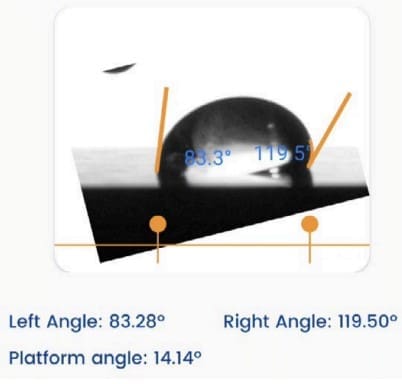
L’angle de contact quantifie la mouillabilité d’une surface en représentant l’angle entre la surface d’un liquide et une surface solide.
Recherche Dropletlab

Sample Image taken from Droplet Lab Tensiometer.

Young – Méthode Laplace

Méthode polynomiale

Angle de contact dynamique

Ideally, when we place a drop on a solid surface, a unique angle exists between the liquid and the solid surface. We can calculate the value of this ideal contact angle (the so-called Young’s contact angle) using Young’s equation. In practice, due to surface geometry, roughness, heterogeneity, contamination, and deformation, the contact angle value on a surface is not necessarily a single consistent value but rather falls within a range. The upper and lower limits of this range are known as the advancing and receding contact angles, respectively. The values of advancing and receding contact angles for a solid surface are highly sensitive to many parameters, such as temperature, humidity, homogeneity, and minor contamination of the surface and liquid. For example, the advancing and receding contact angles of a surface can differ at different locations.

Angle de contact dynamique par rapport à l’angle de contact statique

Les surfaces et les revêtements pratiques présentent naturellement une hystérésis d’angle de contact, indiquant une gamme de valeurs d’équilibre. Lorsque nous mesurons les angles de contact statiques, nous obtenons une seule valeur dans cette plage. S’appuyer uniquement sur des mesures statiques pose des problèmes, tels qu’une mauvaise répétabilité et une évaluation incomplète de la surface en ce qui concerne l’adhérence, la propreté, la rugosité et l’homogénéité.

In practical applications, we need to understand how easily a liquid spreads (advancing angle) and how easily it is removed (receding angle), such as in painting and cleaning. Measuring advancing and receding angles offers a holistic view of liquid-solid interaction, unlike static measurements, which yield an arbitrary value within the range.

Ces informations sont cruciales pour les surfaces du monde réel avec des variations, une rugosité et une dynamique, aidant des industries telles que les cosmétiques, la science des matériaux et la biotechnologie à concevoir des surfaces efficaces et à optimiser les processus.

Découvrez comment la mesure de l’angle de contact est effectuée sur notre tensiomètre

Pour une compréhension plus complète de la mesure de l’angle de contact, lisez notre mesure de l’angle de contact : le guide définitif

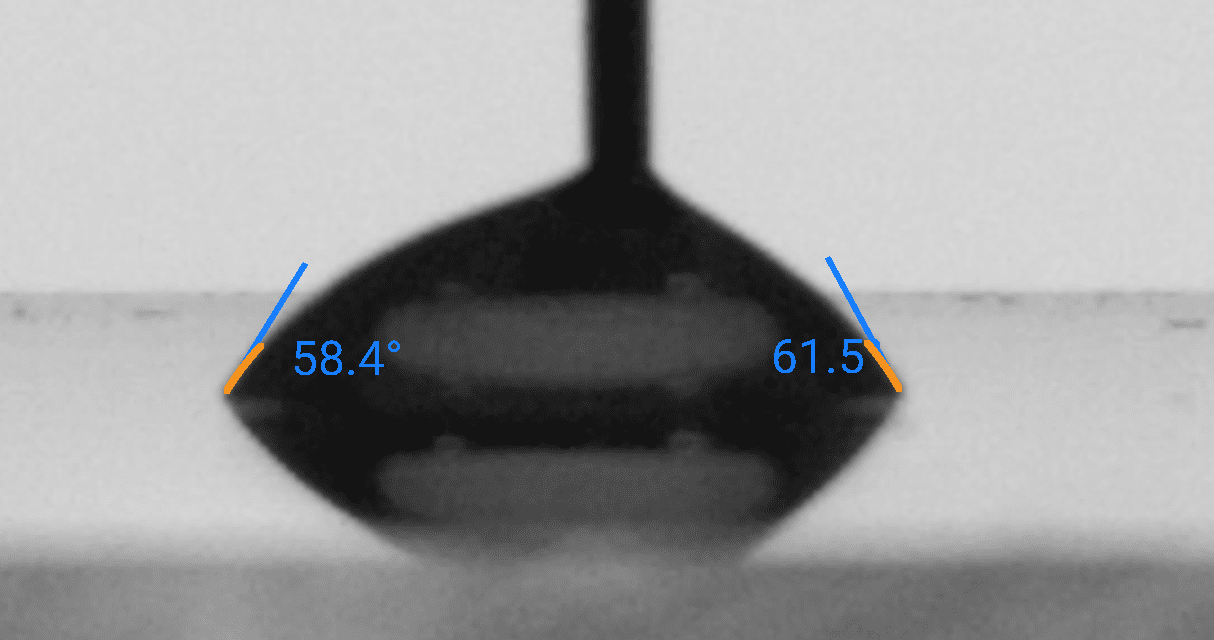
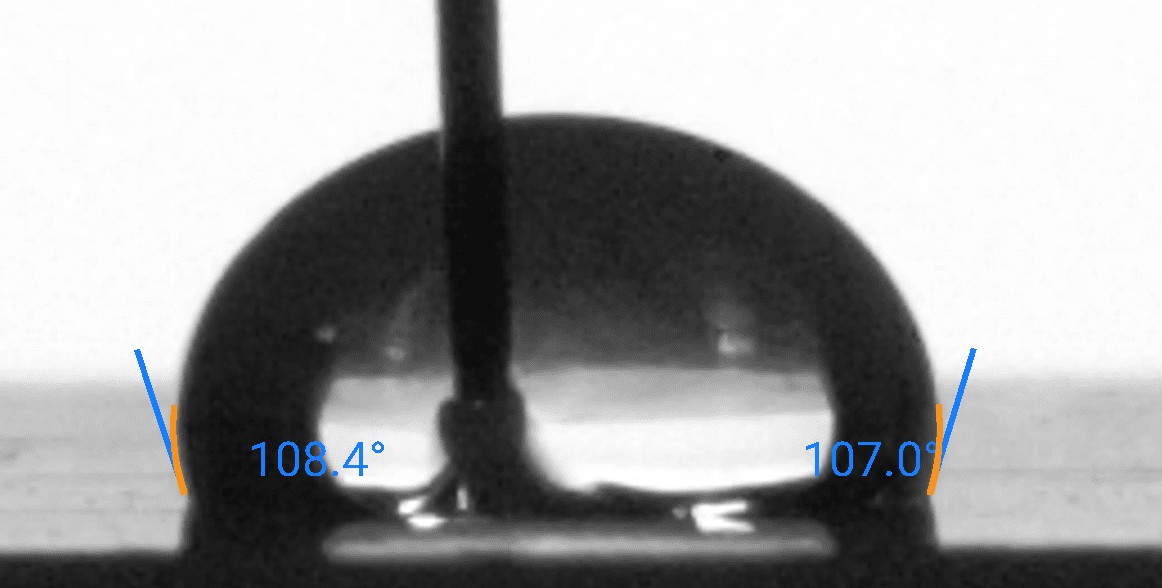
Open Benchmark Data: Contact Angle & Surface Energy

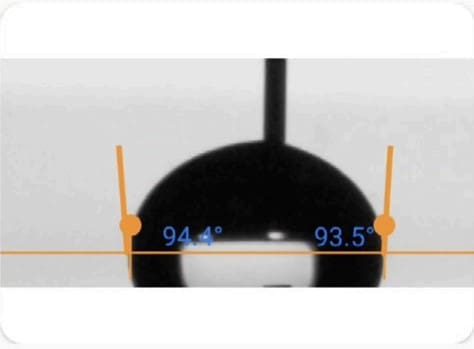
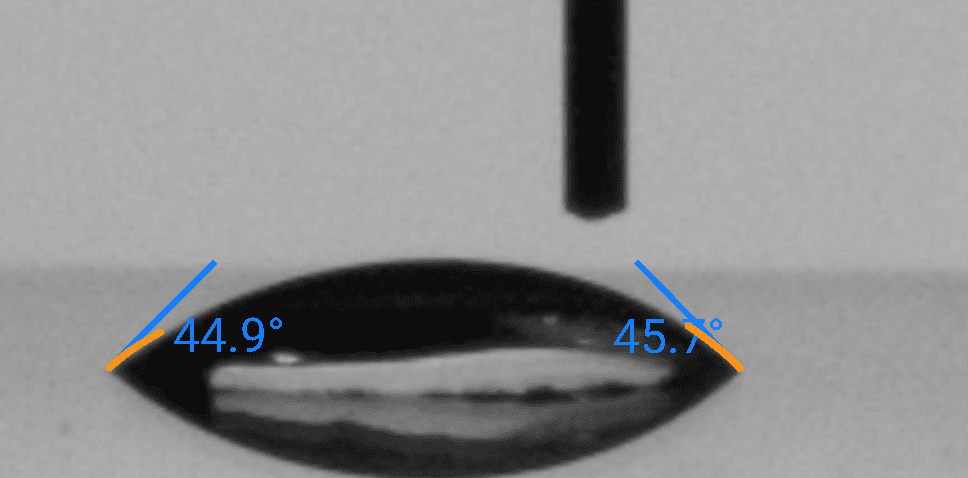
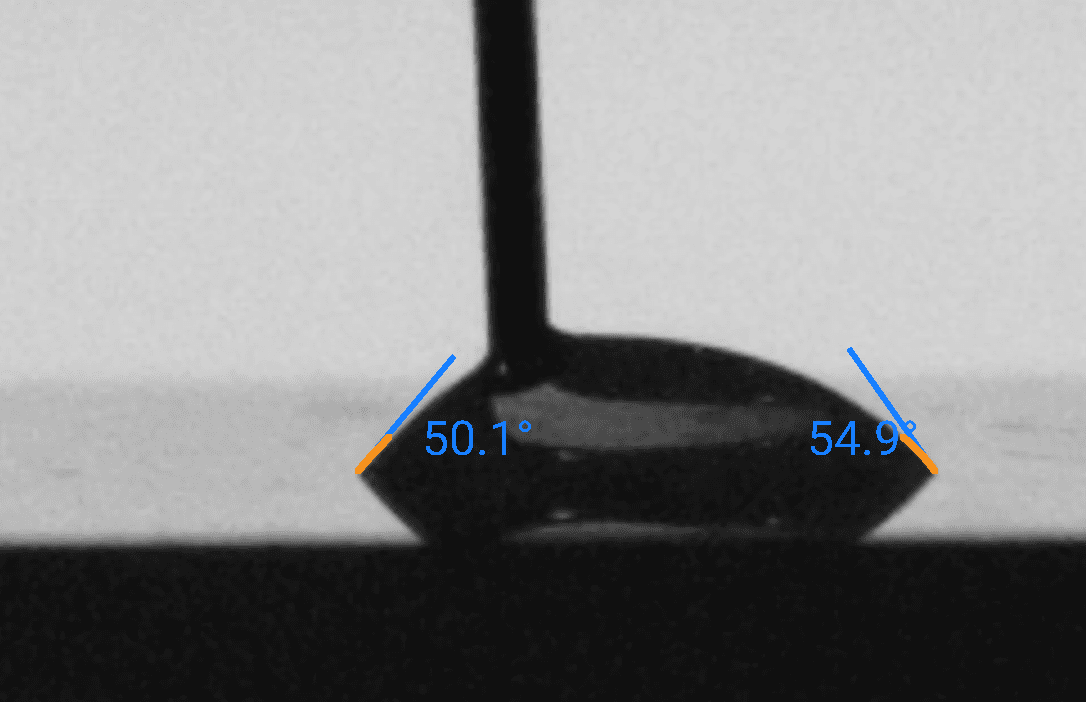
These reference measurements show how deionized water wets four standard substrates measured with the Droplet Lab Dropometer. Use them as visual and numerical benchmarks when you're checking your own sample preparation, treatments, and chemistry.

Full contact angle and surface energy datasets (including additional liquids and statistics) are available on our dataset hub.

Glass - DI Water
Glass - DI Water
Nylon - DI Water
Nylon - DI Water
PMMA - DI Water
PMMA - DI Water
Teflon - DI Water
Teflon - DI Water

The droplet images above are taken from the same benchmark series as our open dataset. For each substrate and probe liquid we report:

● Advancing and receding contact angles (and hysteresis)
● Derived surface energy (SFE) values based on multi-liquid measurements
● Measurement conditions, uncertainties, and sample preparation details

Comparing your own droplet shapes and angles against these references is a fast way to spot contamination, treatment drift, or unexpected changes in wettability.

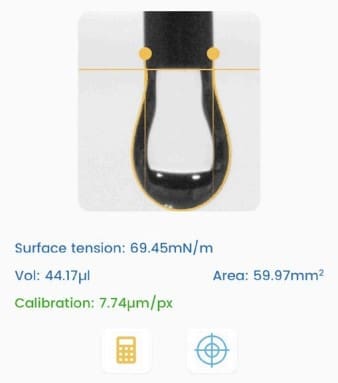
Chapitre 3 : Mesure de la tension superficielle

Cette propriété mesure la force qui agit à la surface d’un liquide, dans le but de minimiser sa surface.

Mesure de la tension superficielle

Sample Image taken from Droplet Lab Tensiometer

Tension superficielle dynamique

La tension superficielle dynamique diffère de la tension superficielle statique, qui fait référence à l’énergie de surface par unité de surface (ou à la force agissant par unité de longueur le long du bord d’une surface liquide).

La tension superficielle statique caractérise l’état d’équilibre de l’interface liquide, tandis que la tension superficielle dynamique tient compte de la cinétique des changements à l’interface. Ces changements peuvent impliquer la présence de tensioactifs, d’additifs ou de variations de température, de pression et de composition à l’interface.

Quand utiliser la mesure dynamique de la tension superficielle

Dynamic surface tension is essential for processes that involve rapid changes at the liquid-gas or liquid-liquid interface, such as droplet and bubble formation, coalescence (change in surface area), the behavior of foams, and the drying of paints (change in composition, e.g., evaporation of solvent). It is measured by analyzing the shape of a hanging droplet over time.

La tension superficielle dynamique s’applique à diverses industries, notamment les cosmétiques, les revêtements, les produits pharmaceutiques, la peinture, l’alimentation et les boissons, ainsi que les processus industriels, où la compréhension et le contrôle du comportement des interfaces liquides sont essentiels pour la qualité du produit et l’efficacité des processus.

Apprenez comment la mesure de la tension superficielle est effectuée sur notre tensiomètre

Pour une compréhension plus complète de la mesure de l’énergie de surface, lisez notre mesure de la tension superficielle : le guide définitif

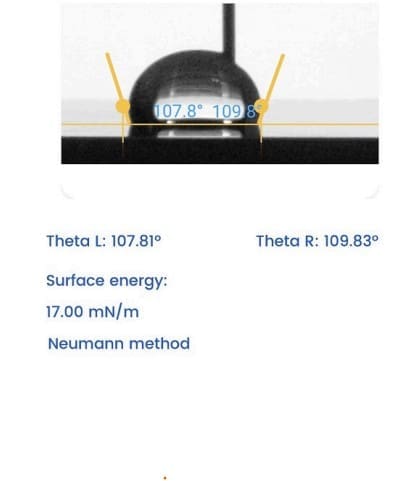
Chapitre 4 : Mesure de l’énergie de surface

L’énergie de surface fait référence à l’énergie nécessaire pour créer une unité de surface d’une nouvelle surface.
231

Sample Image taken from Droplet Lab Tensiometer

Découvrez comment la mesure de l’énergie de surface est effectuée sur notre tensiomètre

Pour une compréhension plus complète de la mesure de l’énergie de surface, lisez notre mesure de l’énergie de surface : le guide définitif

For benchmark contact angle and surface energy values on glass, nylon, PMMA, and Teflon, see the Open Benchmark Data panel above or visit our Dataset Hub for full CSV downloads.

Chapitre 5 : Mesure de l’angle de glissement

L’angle de glissement mesure l’angle auquel un film liquide glisse sur une surface solide. Il est couramment utilisé pour évaluer la résistance au glissement d’une surface.

Angle de glissement 1

Sample Image taken from Droplet Lab Tensiometer

Apprenez comment la mesure de l’angle de glissement est effectuée sur notre tensiomètre

Pour une compréhension plus complète de la mesure de l’angle de glissement, lisez notre Mesure de l’angle de glissement : le guide définitif

Chapitre 6 : Applications dans le monde réel

Within the Fabrics industry, several case studies exemplify the advantages of conducting surface property measurements.

Solvent-Ratio Tuning of Electrospun Polystyrene Fibers to Achieve Highly Water-Repellent Textile-Style Nonwoven Mats

This study electrospins polystyrene fibers from mixed chloroform/DMF solvents to understand how solvent ratio controls fiber surface morphology and resulting hydrophobicity of the collected mats. Using different solvent ratios produces porous polystyrene membranes through coupled nonsolvent- and thermally-induced phase separation during spinning. Scanning electron microscopy shows fiber diameters spanning roughly the sub-micron to several-micron range, with surface pores varying from dense nanopores (tens of nanometers) to larger pores on the order of ~100–200 nm depending on solvent ratio. BET analysis indicates high specific surface area. The resulting porous fiber mats are strongly hydrophobic, with water contact angles exceeding ~143°, supporting potential use in textiles as well as filtration and biomedical applications.

Role of the Droplet Lab Goniometer

The Droplet Lab tabletop goniometer was used to quantify water wettability (hydrophobicity) via contact angle measurements on the electrospun fiber mats (and a smooth PS film reference). The contact angle dataset is the key performance readout linking solvent-driven micro/nano-porosity and bead/roughness features to textile-relevant water repellency, and it enables comparison across solvent ratios and spinning voltages (Characterization section; contact angle results shown in the contact angle figures/tables).

Key Findings

  • All electrospun PS mats were highly hydrophobic, with water contact angles spanning ~130.1° to 143.2° across conditions (Table 5).
  • Higher applied voltage generally increased contact angle, attributed to smaller fiber diameters and increased roughness contributions from pores and/or beads (Figure 7 discussion).
  • The highest contact angles occurred for chloroform:DMF = 30:70, particularly at 22.5 kV (contact angle up to 143.2° ± 0.6°), associated with bead formation that creates hierarchical roughness.
  • Solvent ratio strongly shifts surface texture:
    • 70:30 tends to form thinner, more homogeneous fibers with external surface porosity (~100 nm scale).
    • 50:50 yields largest fiber diameters and lowest contact angles (less favorable for water repellency).
    • 30:70 promotes beads + internal porosity, which increases hydrophobicity via multi-scale roughness.

The wettability behavior is interpreted using Cassie–Baxter wetting, with projected solid fraction f < 0.3 (Table 6), implying air fraction > 0.7 under the droplet—consistent with strong water repellency on porous fibrous surfaces.

Why It Matters

For fabric and textile-style nonwovens, this work shows how solvent formulation (chloroform/DMF ratio) and electrospinning voltage can be used as practical “knobs” to tune fiber diameter, bead density, and pore structure, which directly controls water repellency. A Droplet Lab contact angle method can be translated into a simple QC/acceptance test for water-repellent fibrous webs or coatings—helping teams set specifications (e.g., minimum contact angle threshold), compare process windows, and optimize designs that balance repellency, surface texture, and functional surface area for end uses like moisture-resistant textiles or technical fabric layers.

Method Snapshot

Electrospun polystyrene nonwoven mats (0.15 g/mL PS) were produced from chloroform:DMF = 70:30, 50:50, 30:70 at 15–22.5 kV; wettability was evaluated using static sessile-drop water contact angle on a Droplet Lab tabletop goniometer (ambient conditions). Water surface tension is inherent to the test liquid (not measured in this study); solvent surface tension effects are discussed qualitatively as morphology drivers.

Data Note

Contact angle versus voltage applied plot for samples obtained from different chloroform:DMF ratio.

Figure

Citation (APA Format)

Melo, G. H. F., & Sundararaj, U. (2024). Influence of mixed solvent in the morphology and hydrophobicity of electrospun polystyrene porous fibers. Macromolecular Rapid Communications, 45, 2400403. doi:10.1002/marc.202400403

View Publication →

Crafting Water-Resistant Outdoor Gear

An outdoor gear company, obsessed with crafting weatherproof gear, meticulously measures water droplet interaction with their fabrics to achieve ultimate water repellency. They essentially gauge how much water "wants" to stick to the fabric, ensuring raindrops roll off instead of soaking through. By meticulously analyzing these measurements, they guarantee their products keep adventurers dry and comfortable.

Crafting Water-Resistant Outdoor Gear

Revolutionizing Inkjet Textile Printing

In the captivating world of printing intricate designs on textiles with inkjet technology, experts meticulously tweak the fabric's surface properties to ensure the perfect canvas. Textile and printing companies analyze surface tension and contact angles, not passively observing, but actively manipulating them to guarantee the fabric flawlessly holds the ink. This meticulous attention to detail prevents smudging and blurring, resulting in sharp, vibrant, and eye-catching patterns that come alive on the fabric.

Revolutionizing Inkjet Textile Printing

Nous sommes vos partenaires dans la résolution de votre activité et de votre Défis

Si vous êtes intéressé par la mise en œuvre de ces applications ou de toute autre application, veuillez nous contacter.

Chapitre 7 : Normes et lignes directrices

In an industry where precision reigns supreme, how can Fabrics manufacturers ensure their products withstand scrutiny? The answer lies in standards and guidelines: the compass that guides them through the complex maze of quality and performance.

AATCC TM22 — Water Repellency: Spray Test (Spray Rating)

What it is

AATCC TM22 is a standardized spray exposure and visual rating method used to grade a fabric’s resistance to surface wetting (e.g., 100, 90, 80…). In QC programs, upstream quantitative wetting signals from sessile-drop contact angle (e.g., CA@2 s, ΔCA 2→10 s, variability) can be correlated to TM22 to predict pass/fail and troubleshoot drift, but TM22 remains the final compliance grade.

When to use it

Final pass/fail for water-repellent fabrics

Use TM22 as the acceptance gate for lots, suppliers, or finishing recipes where the spec is defined in TM22 grades.

Line-side triage and drift detection

When grades trend down or failures occur, add upstream contact-angle screening (fixed-time CA + time-dependence + variability) to identify likely causes before repeating full TM22 runs.

In-scope / Out-of-scope

In scope
  • Textile fabrics with or without DWR finishes (woven/knit/nonwoven), where the goal is resistance to surface wetting by water.
  • Standardized spray exposure + visual wetting pattern rating using the TM22 apparatus and official grading scale.
  • QC correlation workflows that relate fixed-time contact-angle signals to TM22 grades within a defined fabric family.
  • Batch controls (known-good control swatch) to monitor apparatus/process drift across runs.
Out of scope
  • Hydrostatic head / bulk water intrusion / “waterproofness” (use dedicated barrier/penetration standards for those claims).
  • Oil repellency or low-surface-tension liquid repellency (separate methods required).
  • Durability claims (laundering/abrasion/weathering) unless paired with separate durability conditioning + re-test standards.
  • Root-cause “proof” from a single metric (TM22 is influenced by both chemistry and structure; diagnostics require rule-outs and process data).

Minimum you must report (checklist)

  • TM22 version/revision used and apparatus identification (spray tester/nozzle ID; verification/maintenance status per your lab practice).
  • Fabric/specimen description (construction, fiber content, face/back if relevant) and finish details (DWR type, add-on target, cure recipe if known).
  • Specimen conditioning (temperature, RH, duration; and any deviations from your lab standard).
  • TM22 run conditions as specified by the official method you follow (water volume, temperature, spray duration, incline angle, nozzle-to-specimen distance, timing).
  • Rating procedure details (number of specimens, timing of rating after spray, rater(s)/training, final reported grade and any averaging rule).
  • If using upstream contact-angle screening: test liquid identity and droplet volume (e.g., 10–15 µL as a starting point).
  • Contact-angle timestamping + statistics: capture time(s) (e.g., [email protected] s ± tolerance, optional [email protected] s) and report median across ≥5 spots + IQR; include ΔCA(2→10 s) if used.
  • Controls & data quality rules: known-good control swatch measured each batch/run, and any rejected/re-run spots due to edge/fit QC failures (unstable baseline, irregular edge, poor fit).

Note: Do not reproduce the official AATCC rating chart in internal documents; reference the official method for the evaluation scale and exact apparatus requirements. Any numeric “Green/Yellow/Red” gates derived from contact-angle screening must be calibrated per fabric family (typically 10–20 swatches spanning grades) and revalidated after weave/fiber/finish/cure/conditioning changes.

How to interpret results (guardrails)

  • TM22 grade is the official outcome; treat contact-angle metrics only as leading indicators and triage signals, not a replacement.
  • Always report contact-angle capture time; never compare CA values taken at different times after deposition (2 s vs 10 s is not interchangeable).
  • Large ΔCA(2→10 s) or strong time dependence usually indicates wicking/penetration dynamics are dominating on that fabric structure—tighten timing, consider dual-timepoint reporting for that family, and adjust cure/add-on/structure before burning TM22 cycles.
  • High spot-to-spot variability (IQR) points to heterogeneity/non-uniform finish or texture effects—confirm with the control swatch and process checks before attributing the issue to “chemistry” alone.

Maintenant, c’est à votre tour

We hope this guide showed you how to apply surface science in the Fabrics industry.

Maintenant, nous aimerions vous céder la parole :

Feel free to leave a comment below—we’d love to hear from you.

Laisser une réponse

Votre adresse e-mail ne sera pas publiée. Les champs obligatoires sont marqués *


Télécharger l’expérience