Contenu

Construction navale Industrie
The Practical Guide to Surface Science (2026)

?s=100&d=m
Écrit par
No biography added yet.
Lire la suite
?s=100&d=m
Reviewed by
N/A
No biography added yet.
Lire la suite
?s=100&d=m
Written By

No biography added yet.

?s=100&d=m
Évalué par

N/A N/A

No biography added yet.

This is a practical guide to Surface Science for researchers working in the Shipbuilding Industry.

Dans ce tout nouveau guide, vous apprendrez tout sur :

  • Crucial surface science principles
  • The significance of surface science measurements for the Shipbuilding industry
  • Normes et directives ASTM applicables

Plongeons dans le vif du sujet.

shipbuilding

Chapitre 1 : Introduction

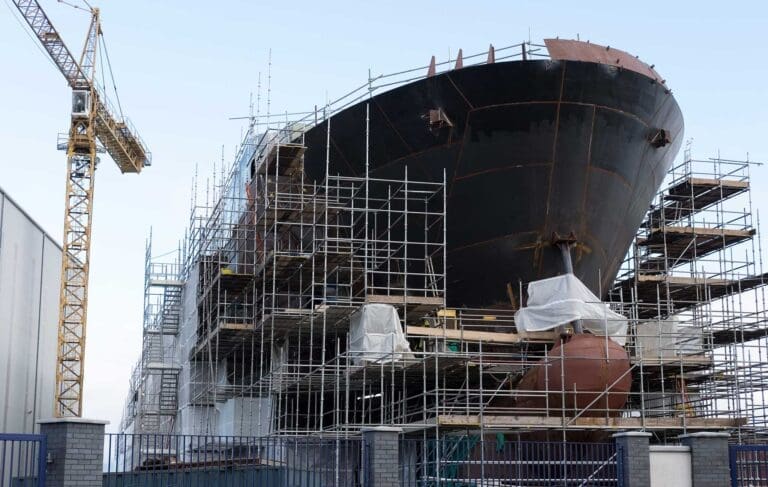
The shipbuilding industry encompasses both the engineering behind ship development and the industrial sectors responsible for completing and repairing ships. This complex field involves various sectors, including the construction of vessels for commercial shipping, naval defense, and recreational boating. Surface properties such as contact angle, sliding angle, surface tension, and surface energy are crucial for ensuring ships’ integrity, performance, and longevity.

We use the following surface properties to understand the behavior of Shipbuilding products and improve their quality.

Chapitre 2 : Mesure de l’angle de contact

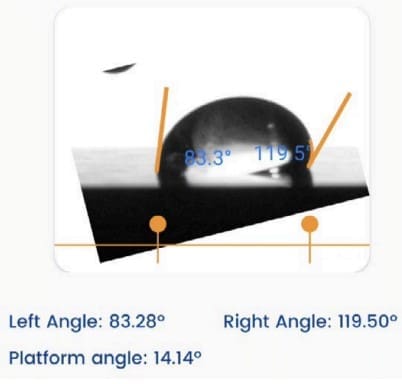
L’angle de contact quantifie la mouillabilité d’une surface en représentant l’angle entre la surface d’un liquide et une surface solide.
Recherche Dropletlab

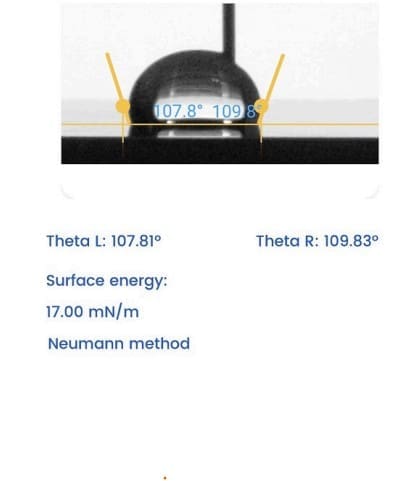
Sample Image taken from Droplet Lab Tensiometer.

Young – Méthode Laplace

Méthode polynomiale

Angle de contact dynamique

Ideally, when we place a drop on a solid surface, a unique angle exists between the liquid and the solid surface. We can calculate the value of this ideal contact angle (the so-called Young’s contact angle) using Young’s equation. In practice, due to surface geometry, roughness, heterogeneity, contamination, and deformation, the contact angle value on a surface is not necessarily a single consistent value but rather falls within a range. The upper and lower limits of this range are known as the advancing and receding contact angles, respectively. The values of advancing and receding contact angles for a solid surface are highly sensitive to many parameters, such as temperature, humidity, homogeneity, and minor contamination of the surface and liquid. For example, the advancing and receding contact angles of a surface can differ at different locations.

Angle de contact dynamique par rapport à l’angle de contact statique

Les surfaces et les revêtements pratiques présentent naturellement une hystérésis d’angle de contact, indiquant une gamme de valeurs d’équilibre. Lorsque nous mesurons les angles de contact statiques, nous obtenons une seule valeur dans cette plage. S’appuyer uniquement sur des mesures statiques pose des problèmes, tels qu’une mauvaise répétabilité et une évaluation incomplète de la surface en ce qui concerne l’adhérence, la propreté, la rugosité et l’homogénéité.

In practical applications, we need to understand how easily a liquid spreads (advancing angle) and how easily it is removed (receding angle), such as in painting and cleaning. Measuring advancing and receding angles offers a holistic view of liquid-solid interaction, unlike static measurements, which yield an arbitrary value within the range.

Ces informations sont cruciales pour les surfaces du monde réel avec des variations, une rugosité et une dynamique, aidant des industries telles que les cosmétiques, la science des matériaux et la biotechnologie à concevoir des surfaces efficaces et à optimiser les processus.

Découvrez comment la mesure de l’angle de contact est effectuée sur notre tensiomètre

Pour une compréhension plus complète de la mesure de l’angle de contact, lisez notre mesure de l’angle de contact : le guide définitif

Open Benchmark Data: Contact Angle & Surface Energy

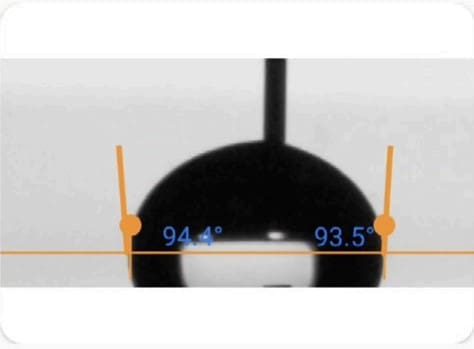
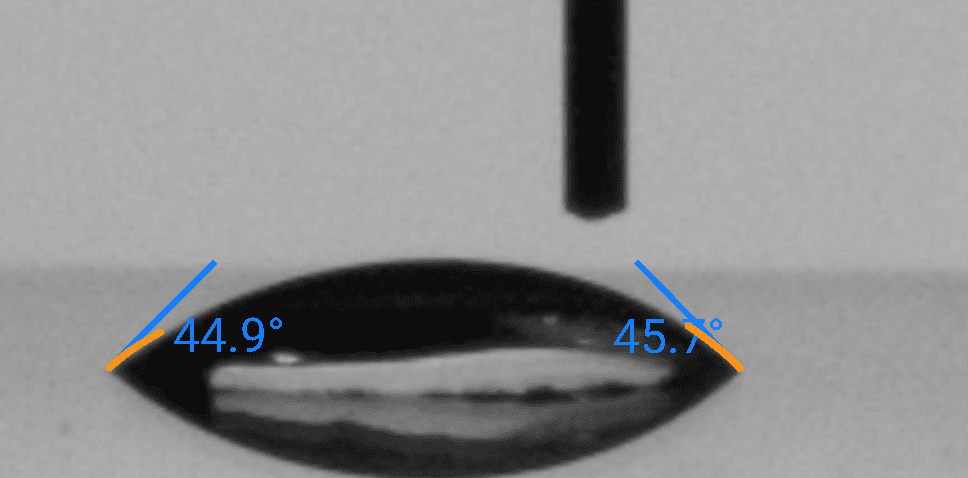
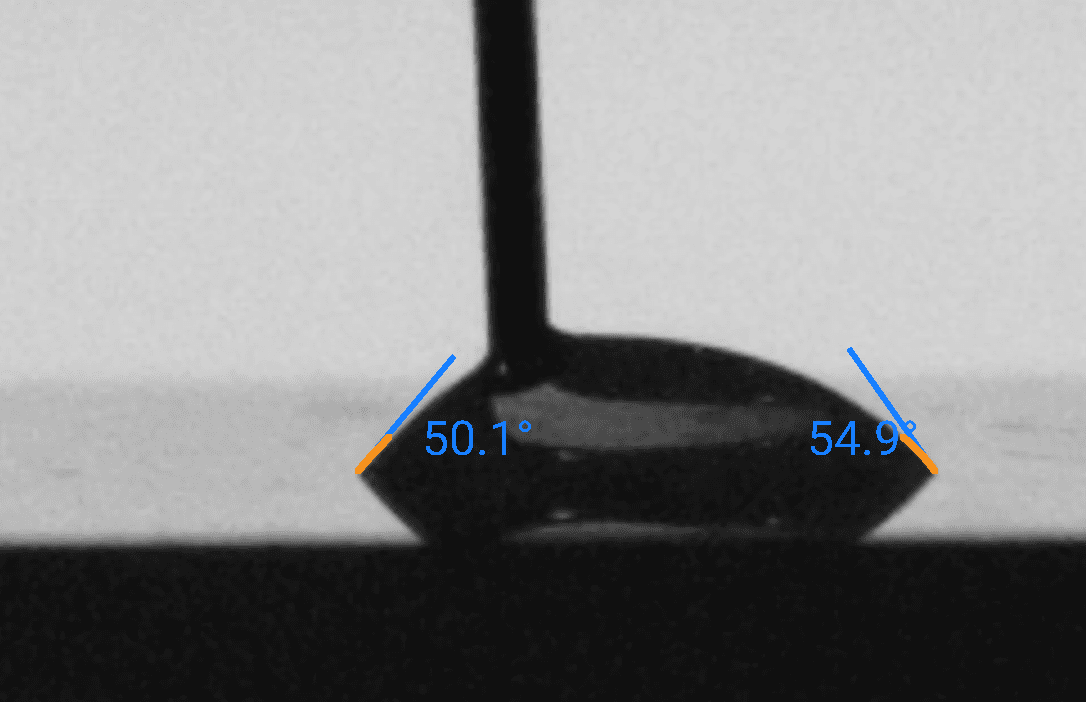
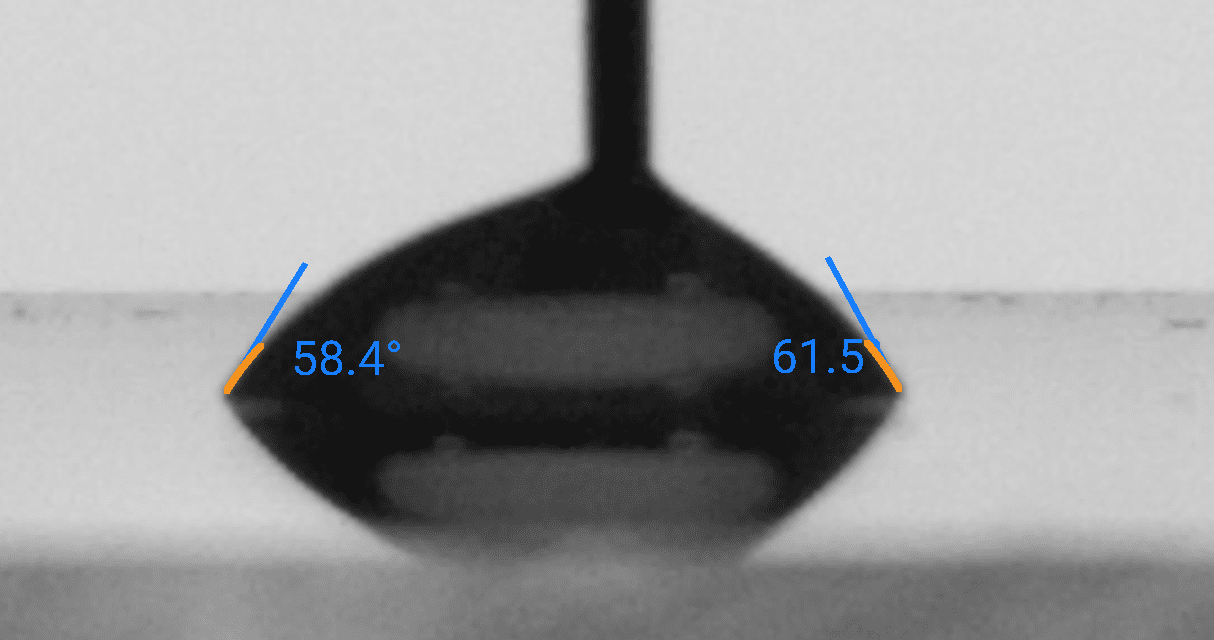
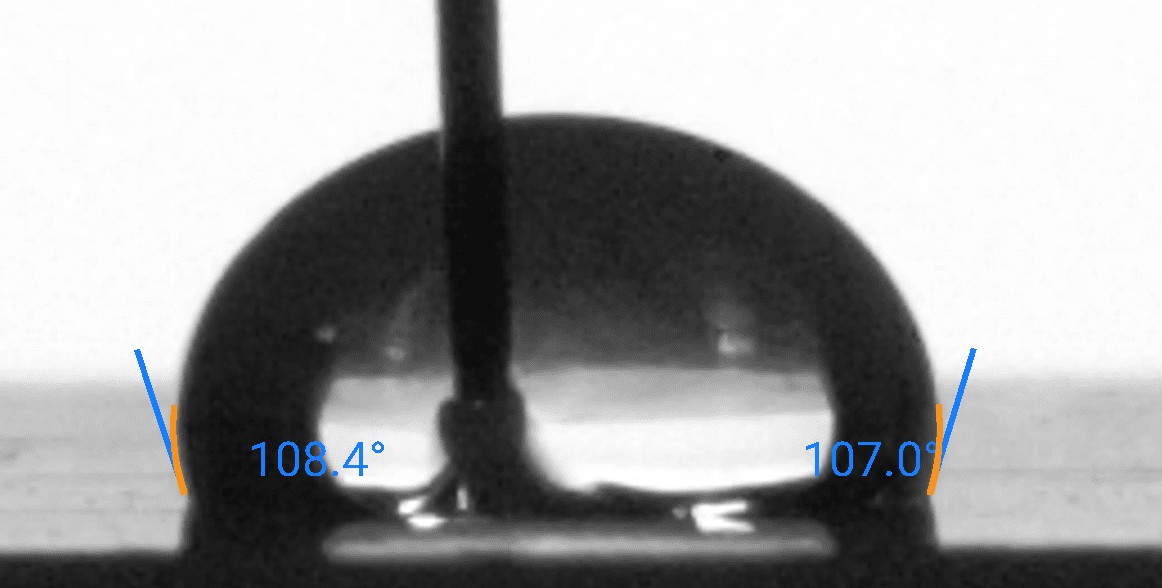
These reference measurements show how deionized water wets four standard substrates measured with the Droplet Lab Dropometer. Use them as visual and numerical benchmarks when you're checking your own sample preparation, treatments, and chemistry.

Full contact angle and surface energy datasets (including additional liquids and statistics) are available on our dataset hub.

Glass - DI Water
Glass - DI Water
Nylon - DI Water
Nylon - DI Water
PMMA - DI Water
PMMA - DI Water
Teflon - DI Water
Teflon - DI Water

The droplet images above are taken from the same benchmark series as our open dataset. For each substrate and probe liquid we report:

● Advancing and receding contact angles (and hysteresis)
● Derived surface energy (SFE) values based on multi-liquid measurements
● Measurement conditions, uncertainties, and sample preparation details

Comparing your own droplet shapes and angles against these references is a fast way to spot contamination, treatment drift, or unexpected changes in wettability.
Chapitre 3 : Mesure de la tension superficielle

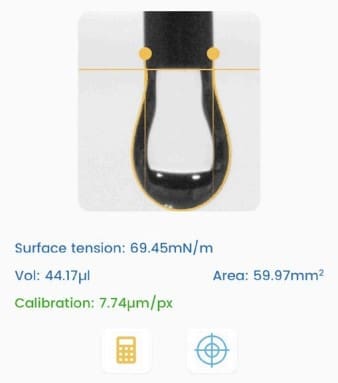
Cette propriété mesure la force qui agit à la surface d’un liquide, dans le but de minimiser sa surface.

Mesure de la tension superficielle

Sample Image taken from Droplet Lab Tensiometer

Tension superficielle dynamique

La tension superficielle dynamique diffère de la tension superficielle statique, qui fait référence à l’énergie de surface par unité de surface (ou à la force agissant par unité de longueur le long du bord d’une surface liquide).

La tension superficielle statique caractérise l’état d’équilibre de l’interface liquide, tandis que la tension superficielle dynamique tient compte de la cinétique des changements à l’interface. Ces changements peuvent impliquer la présence de tensioactifs, d’additifs ou de variations de température, de pression et de composition à l’interface.

Quand utiliser la mesure dynamique de la tension superficielle

Dynamic surface tension is essential for processes that involve rapid changes at the liquid-gas or liquid-liquid interface, such as droplet and bubble formation, coalescence (change in surface area), the behavior of foams, and the drying of paints (change in composition, e.g., evaporation of solvent). It is measured by analyzing the shape of a hanging droplet over time.

La tension superficielle dynamique s’applique à diverses industries, notamment les cosmétiques, les revêtements, les produits pharmaceutiques, la peinture, l’alimentation et les boissons, ainsi que les processus industriels, où la compréhension et le contrôle du comportement des interfaces liquides sont essentiels pour la qualité du produit et l’efficacité des processus.

Apprenez comment la mesure de la tension superficielle est effectuée sur notre tensiomètre

Pour une compréhension plus complète de la mesure de l’énergie de surface, lisez notre mesure de la tension superficielle : le guide définitif

Chapitre 4 : Mesure de l’énergie de surface

L’énergie de surface fait référence à l’énergie nécessaire pour créer une unité de surface d’une nouvelle surface.
231

Sample Image taken from Droplet Lab Tensiometer

Découvrez comment la mesure de l’énergie de surface est effectuée sur notre tensiomètre

Pour une compréhension plus complète de la mesure de l’énergie de surface, lisez notre mesure de l’énergie de surface : le guide définitif

For benchmark contact angle and surface energy values on glass, nylon, PMMA, and Teflon, see the Open Benchmark Data panel above or visit our Dataset Hub for full CSV downloads.

Chapitre 5 : Mesure de l’angle de glissement

L’angle de glissement mesure l’angle auquel un film liquide glisse sur une surface solide. Il est couramment utilisé pour évaluer la résistance au glissement d’une surface.

Angle de glissement 1

Sample Image taken from Droplet Lab Tensiometer

Apprenez comment la mesure de l’angle de glissement est effectuée sur notre tensiomètre

Pour une compréhension plus complète de la mesure de l’angle de glissement, lisez notre Mesure de l’angle de glissement : le guide définitif

Chapitre 6 : Applications dans le monde réel

Within the Shipbuilding industry, several case studies exemplify the advantages of conducting surface property measurements.

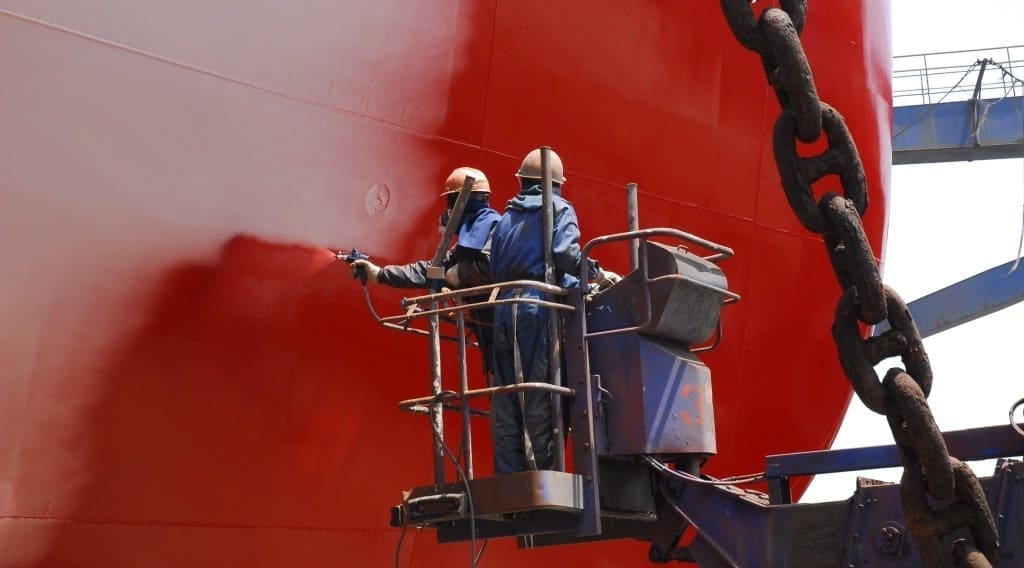
Unevenness in Surface Coating

Défi: A ship painting company faced uneven surface coatings due to the coating fluid's viscosity, surface tension, and the substrate's contact angle.


Solution:
The company’s engineering team discovered that using a coating liquid with a contact angle less than 90° caused a pinning effect, reducing surface unevenness. By adjusting the contact angle to create this effect, they mitigated the impact of uneven coatings, leveraging the interplay between fluid viscosity and the substrate's surface energy.
Unevenness in Surface Coating

Costly and Complex Superhydrophobic Coating Process

Défi: The superhydrophobic coatings used in shipbuilding were expensive and complicated to fabricate.


Solution:
Researchers developed cost-effective, mechanically stable micro/nano superhydrophobic coatings by combining laser processing with low-surface energy materials. These coatings, exhibiting excellent hydrophobicity through contact angle and sliding angle measurements, provided durable water repellency, simplifying the superhydrophobic coating process.

Costly and Complex Superhydrophobic Coating Process

Innovation en matière de revêtement de coque dans le transport de marchandises

Défi: Les compagnies de transport de marchandises devaient réduire leur consommation de carburant et leurs émissions.


Solution:
Companies adopted innovative hull coatings with low surface energy and sliding angles to minimize friction with seawater. By enhancing hydrodynamic efficiency, these coatings led to significant fuel savings, reduced operational costs, and a lower carbon footprint. Droplet Lab's portable instrument can enable accurate measurement of surface energy and sliding angles, ensuring these coatings' effectiveness in real maritime conditions.
Innovation en matière de revêtement de coque dans le transport de marchandises

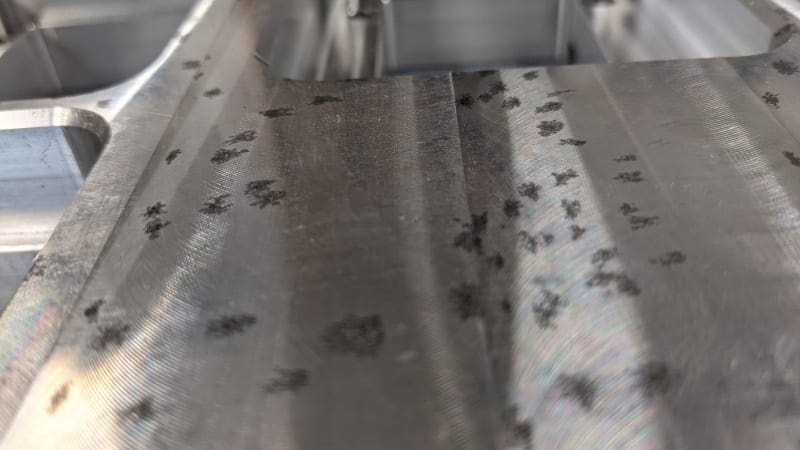
Corrosion Issues with Aluminum 7075

Défi: Aluminum 7075, despite its high strength, suffered from corrosion, limiting its use in subsea industries.


Solution: The research team experimented with bare aluminum and oil-impregnated anodic aluminum oxide (AAO) surfaces. Salt spray and pressure tests revealed that the oil-impregnated AAO maintained a high contact angle, significantly improving corrosion resistance. This modification made Aluminum 7075 viable for subsea applications.
Corrosion Issues with Aluminum 7075

Hydrophobic Deck Surfaces

Défi: Slippery deck surfaces posed safety concerns.


Solution: To enhance deck surface hydrophobicity, engineers performed contact angle measurements on various surface treatments. Optimizing these treatments increased hydrophobicity, reducing slip risks in wet conditions and improving safety.
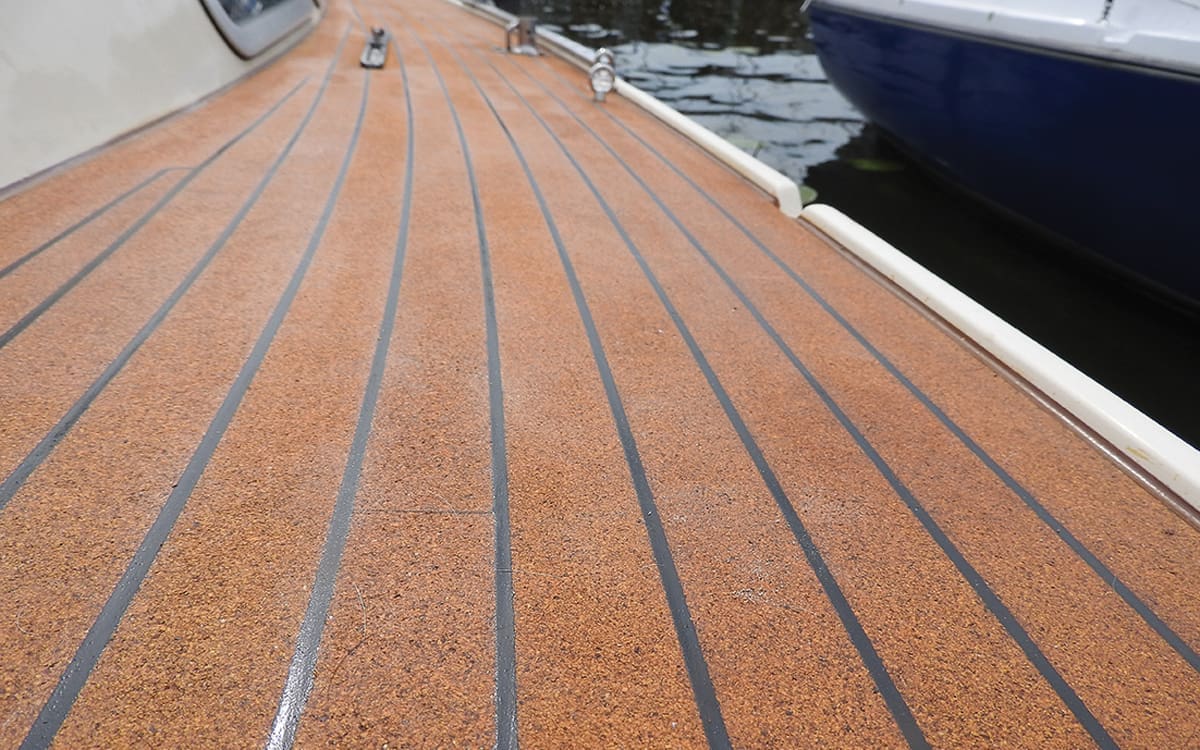
Hydrophobic Deck Surfaces

Nous sommes vos partenaires dans la résolution de votre activité et de votre Défis

Si vous êtes intéressé par la mise en œuvre de ces applications ou de toute autre application, veuillez nous contacter.

Chapitre 7 : Normes et lignes directrices

In an industry where precision reigns supreme, how can Shipbuilding manufacturers ensure their products withstand scrutiny? The answer lies in standards and guidelines: the compass that guides them through the complex maze of quality and performance.

ASTM D3359 — Paint Adhesion by Tape Test (Method A: X‑Cut; Method B: Crosshatch/Lattice)

What it is

A destructive coating-adhesion outcome test: you cut through the cured coating to the substrate, apply pressure-sensitive tape, remove it, and classify how much coating detaches. For a more actionable shipyard workflow, pair D3359 with an upstream wettability gate (e.g., water contact angle at a fixed timestamp and optional surface free energy trend) to detect surface-prep drift before coating.

When to use it

Production acceptance / QA-QC

Use D3359 to confirm the coating system meets the project’s required adhesion class after cure on representative panels/areas.

Troubleshooting & drift control

Use D3359 when ratings trend down, and use contact angle/SFE trending to quickly triage whether the likely issue is surface readiness (cleaning/treatment/contamination) vs coating/cure changes.

In-scope / Out-of-scope

In scope
  • Adhesion classification of coating films to substrates using tape removal after X-cut (A) or crosshatch/lattice (B) cuts.
  • Comparative QC and process monitoring across lots, shifts, zones, or prep recipes (blast/clean/convert/plasma/corona/primer).
  • Use on common shipbuilding substrates (e.g., steel, aluminum, polymers/composites) where a cut-and-tape method is practical.
  • Workflow augmentation with quantitative wettability (contact angle + variability; optional SFE trend) as a pre-coat readiness check and post-failure diagnostic.
Out of scope
  • Absolute adhesion strength/energy measurements (use pull-off or other strength-based methods if you need force/MPa).
  • Universal wettability thresholds: contact angle/SFE limits are not portable across all substrates and coating systems without calibration.
  • Root-cause proof by tape test alone: D3359 indicates the outcome, not the single cause (chemistry, cure, roughness, intercoat issues can dominate).
  • Intercoat failure localization in multi-coat systems without supplemental analysis (D3359 may not uniquely identify which interface failed).

Minimum you must report (checklist)

  • Substrate + surface prep history: material, finish/profile, cleaning steps, pretreatment/conversion/treatment recipe, and time since prep.
  • Coating system + cure: products/batches, number of coats, dry film thickness (DFT), cure schedule, and time since cure.
  • D3359 method used: Method A (X-cut) or B (crosshatch/lattice) and the cut tool/spacing used per your SOP.
  • Tape details + peel procedure: tape identification/lot, application method (pressure), dwell time, peel angle/rate (as controlled by your SOP).
  • Replicates + locations: number of test areas, exact zones (edge/center; upstream/downstream), and any mapping approach used.
  • D3359 result(s): adhesion class reported as 5A/5B (best) → 0A/0B (worst), including any re-tests and acceptance rule.
  • Wettability gate data (if used): test liquid (e.g., DI water), CA @ fixed time (e.g., 2.0 s), droplet volume, ≥5 spots, and median + IQR (plus a control panel result).
  • Evidence package: photos of cuts/peel area and brief notes on apparent failure character (clean peel vs flaking, intercoat clues, localized defects).

D3359 remains the adhesion outcome test; contact angle/SFE are surface-sensitive indicators that help you catch risk early and diagnose drift, but they do not “guarantee” adhesion. Any numeric wettability gates must be calibrated to your specific substrate + pretreatment + coating system by correlating to D3359 outcomes.

How to interpret results (guardrails)

  • Use your project/spec acceptance class: higher D3359 class means less coating removal (better adhesion); define pass/fail per system and service environment.
  • Trend + variability matter: a downward shift in D3359 class, or widening spread across zones, is a strong “process drift” signal—don’t average it away.
  • Wettability triage (probabilistic): rising WCA@time and/or higher IQR versus a known-good control typically points first to cleaning/contamination/treatment non-uniformity rather than coating chemistry.
  • Compare like-for-like only: hold constant method (A vs B), cutter/tape/procedure, coating thickness, cure age, and environment—otherwise apparent changes may be procedural, not material.

Maintenant, c’est à votre tour

We hope this guide showed you how to apply surface science in the Shipbuilding industry.

Maintenant, nous aimerions vous céder la parole :

Feel free to leave a comment below—we’d love to hear from you.

Laisser une réponse

Votre adresse e-mail ne sera pas publiée. Les champs obligatoires sont marqués *


Télécharger l’expérience