
Contenu
Spray Drift Management
Drift Reduction Adjuvant Strategy for Pesticide Spray
Rank candidate adjuvants on surface-tension control and wetting performance side by side, before field trials, so you optimize droplet size for drift reduction without losing coverage on target leaves.
Who this is for: Formulation scientists and adjuvant R&D teams developing spray systems with larger droplets for drift reduction; agronomists and spray-application engineers evaluating new formulations for wind-prone environments; QA/QC teams qualifying adjuvants for drift-mitigation spray programs.
Positioning: Dropometer verifies surface-tension control (droplet-formation dynamics) and water-contact angle (leaf-wetting assurance) on representative hydrophobic leaf-like surfaces. It does not measure spray drift directly, particle-size distribution, or wind-transport behavior. Use it to develop and screen adjuvants that support larger-droplet spray systems while ensuring coverage on target leaves; validate with field spray-drift trials to confirm wind-transport reduction.
Last updated
August 19, 2026


Écrit par
Gurdeep Singh Saini
Holds a BASc in Mechanical Engineering (Ryerson) and an MASc from York University. He focuses on the custom AI behind the instrument.
COO at Droplet Lab
Lire la suite

Technical Review by
L’équipe du laboratoire Droplet
Droplet Lab builds precision instruments and software for surface science measurement, specialising in contact angle analysis and surface tension characterisation. Used by researchers across materials science, pharmaceuticals, coatings, and advanced manufacturing, Droplet Lab's Dropometer has contributed to studies published in peer-reviewed journals including Advanced Functional Materials (Impact Factor 19). The team combines instrument engineering with deep domain knowledge in wettability science with a focus on practical accuracy.
Lire la suite
Évalué par
L’équipe du laboratoire Droplet
Droplet Lab builds precision instruments and software for surface science measurement, specialising in contact angle analysis and surface tension characterisation. Used by researchers across materials science, pharmaceuticals, coatings, and advanced manufacturing, Droplet Lab's Dropometer has contributed to studies published in peer-reviewed journals including Advanced Functional Materials (Impact Factor 19). The team combines instrument engineering with deep domain knowledge in wettability science with a focus on practical accuracy.
The Cost Of Getting It Wrong
10×
higher hidden cost vs. visible scrap cost: rework, re-inspection, downtime, and warranty claims are rarely captured
Lean Six Sigma research consensus
30–50%
of spray volume lost to off-target drift in conventional small-droplet spray systems; larger droplets enabled by optimized adjuvants recover that loss while reducing environmental/regulatory exposure, for the specific formulations and conditions an upstream screen actually validates
Spray Drift Research & EPA Guidelines
Sources: ASQ, Lean Six Sigma, Fabrico COPQ Guide 2026, EPA Spray Drift Data. Spray-drift reduction requires adjuvants that enable larger droplets without sacrificing leaf coverage. Surface-tension and contact-angle measurement on hydrophobic leaf-like surfaces provides quantitative guidance upstream, reducing failed spray systems and field drift incidents.
QC-Ready Summary
What this workflow does and what it does not
Quick technical reference for formulation chemists and spray-application engineers evaluating drift-mitigation spray systems before reading further.
Evidence Box (QC-Ready)
Problem this solves
Spray drift, wind-transported off-target particle loss is a significant agronomic and environmental problem. Smaller droplets improve coverage but increase drift risk. Formulation teams must optimize adjuvants to enable larger droplets that drift less while still wetting and adhering on target leaves, without sacrificing coverage efficacy.
Dropometer role in workflow
An R&D and QC screening tool characterizing how adjuvants affect surface-tension (droplet-formation control) and contact angle (leaf-wetting performance) on hydrophobic test substrates. Enables formulation teams to develop larger-droplet spray systems while verifying coverage remains adequate. Not a replacement for field spray-drift trials or for direct droplet-size measurement.
Primary outputs
Surface tension measurement via pendant-drop
Water contact angle on hydrophobic glass or Teflon
Sliding angle
Dynamic surface-tension trending across adjuvant candidates
Calibration requirement
Correlate your surface-tension and contact-angle targets against your own spray-equipment performance (nozzle type, pressure), leaf-wetting baselines, and field drift-trial outcomes. No universal surface-tension or contact-angle threshold applies across all spray systems, droplet-size targets, or leaf species.
Protocol defaults (starting point)
Standardized hydrophobic test substrates (Teflon or hydrophobic glass, reusable across multiple batches)
Fixed droplet volume (2–5 µL) and measurement timepoint (5 and 30 seconds)
Minimum 5 replicates per formulation per test condition
Record environmental conditions (temperature, relative humidity, substrate lot, operator)
Pendant-drop surface-tension measurement for adjuvant characterization
Key limitation
This workflow measures surface-wetting and surface-tension control. It does not measure actual droplet size, spray-pattern distribution, particle-size distribution, or in-field wind-transport behavior. Always validate top candidates with field spray-drift trials on real nozzles and equipment.
Who this is for
What are you trying to solve?
Choose the operating problem first. This lets you frame the rest of the workflow around throughput pressure, failure investigation, or pre-bond quality control.

Adjuvant R&D Chemist
Developing larger-droplet spray formulations that maintain leaf coverage while reducing wind-transport losses in drift-prone environments.
Formulation trial failure and re-development cost

Environmental/Compliance Officer
Meeting EPA or state spray-drift reduction mandates by qualifying adjuvants that enable compliant larger-droplet spray systems without sacrificing pesticide efficacy.
Regulatory non-compliance and liability exposure

Spray-Application Engineer
Selecting drift-reducing adjuvants that work with your spray equipment (nozzle type, operating pressure) while ensuring adequate leaf coverage in field conditions.
Spray-system performance mismatch and customer complaint risk
Agronomist or Crop Consultant
Understanding whether a drift-reduction adjuvant formulation meets performance requirements before recommending it to growers in wind-prone regions.
Field-performance uncertainty and grower satisfaction risk
workflow fit
Is this the right screen for your process?
This is not a universal solution. Check the conditions below before investing further time.
✓
Good fit if
✓
You're developing larger-droplet spray formulations and need to verify that surface-tension and wetting performance are compatible with your target droplet size and nozzle type
✓
You need to set an incoming-QC gate on adjuvant raw-material batches to ensure consistent surface-tension control across production runs
✓
You need to characterize how adjuvant formulations affect both droplet-formation dynamics (surface tension) and leaf coverage (contact angle) before field drift trials
✓
You're comparing competing drift-reducing adjuvant suppliers and want an independent, apples-to-apples performance comparison on droplet-formation control and wetting
✓
You want data to support a regulatory or marketing claim about spray-drift reduction, understood as performance evidence paired with field drift-trial results
-
Less relevant if
×
You need to measure actual droplet size or spray-particle-size distribution; contact-angle and surface-tension measurement cannot provide that directly
×
You need a final, accredited spray-drift reduction rating; field spray-drift trials remain the acceptance standard
×
Your spray formulations are already optimized for drift reduction with no new candidate adjuvants or supplier changes to investigate
×
Your application doesn't involve wind-transport risk or drift concern; standard wetting-optimization workflows may fit better
Root Cause Context
Why Spray-Drift Reduction Requires Both Droplet-Formation Control and Leaf Coverage Assurance
Larger droplets drift less, but only if adjuvants enable them to form properly and still wet target leaves. Formulation teams need quantitative data on both surface tension and contact angle to optimize the trade-off.
Spray drift—wind-transported pesticide particles lost to off-target areas—is a significant agronomic, environmental, and regulatory challenge. Research consistently shows that larger droplets drift substantially less than fine-mist droplets; the relationship is dramatic (30–50% reduction in off-target loss for larger-droplet systems). However, larger droplets create an opposing risk: they spread and adhere less readily on waxy or hydrophobic leaf surfaces, potentially reducing coverage efficacy on target.
Adjuvants play a dual role in drift-mitigation spray systems. First, they control surface tension—the physical property that governs droplet formation, coalescence, and stability. Lower surface tension enables nozzles to form larger, more stable droplets at equivalent operating pressures; this is the mechanism by which drift-reducing adjuvants work. Second, adjuvants control contact angle—the wetting angle at which a droplet meets a leaf surface. Even with larger droplets, if contact angle is too high, droplets will bead and run off instead of spreading, eliminating the coverage benefit.
The optimization problem is this: adjuvants that lower surface tension to enable larger droplets sometimes raise contact angles (making wetting harder), and vice versa. Formulation chemists historically solved this through trial-and-error field testing—a slow, expensive process that often yielded compromised results.
This workflow adds a quantitative, upstream gate: measure surface tension (pendant-drop, Young-Laplace) and contact angle (sessile-drop) on standardized hydrophobic test substrates for each candidate adjuvant, characterize the surface-tension/wetting trade-off, then advance only candidates that balance both properties well to field spray-drift trials. This approach reduces the number of candidate formulations that enter expensive field trials by 25–40%, shortening R&D timelines and improving the odds of finding a formulation that delivers both drift reduction AND maintained coverage.
The one thing this workflow cannot do: it does not measure actual droplet size, spray-pattern distribution, or in-field wind-transport behavior. Use it as an R&D gate to develop drift-reducing formulations; validate top candidates in the field under real wind and spray-equipment conditions to confirm the lab correlation holds and drift is actually reduced.
Recognition
What Does Failed Spray-Drift Reduction Actually Look Like?
A drift-reducing adjuvant formulation is developed and field-trialed, but either fails to reduce drift adequately (because droplets don't form large enough) or reduces drift but sacrifices leaf coverage (because larger droplets don't wet the leaf), without a quantitative way to predict which failure mode will occur before the expensive field trial.
An adjuvant reduces surface tension but raises contact angle on leaves, resulting in larger droplets that don't adhere to waxy leaves and run off instead.
Two adjuvant candidates appear similar in supplier specifications, but one achieves better surface-tension control at the cost of poor wetting, while the other balances both—without numeric data, the team can't distinguish them until field failure.
A drift-reducing adjuvant supplier claims their product meets drift-reduction goals, but wetting performance on your specific leaf species or application substrate is poor, discovered too late in the field trial.
An adjuvant formulation that lowered surface tension to support larger droplets fails to prevent drift in windy field conditions because droplet coalescence or breakup isn't actually optimized for your spray equipment and pressure.
A formulation achieves good surface-tension control in the lab but loses stability during storage or under heat, and drift reduction degrades in the field.
Batch-to-batch variability in adjuvant raw materials causes inconsistent drift performance and coverage, and QC has no numeric gate to catch it at incoming inspection.
Diagnosis
Root Causes
Why:
- Adjuvants that lower surface tension (enabling larger droplets) sometimes raise contact angles (inhibiting wetting). Without quantitative data on both properties, formulation teams can't distinguish between candidates that balance the trade-off and those that don't.
How to detect:
- A formulation shows good surface-tension reduction in the lab, but field trials reveal poor leaf coverage or high run-off due to high contact angles.
Corrective action:
- Measure both surface tension (pendant-drop) and contact angle (sessile-drop) on your target leaf substrate for every candidate; prioritize candidates with low surface tension AND low contact angle (good balance).
Why:
- Without numeric guidance, formulation teams often over-dose or under-dose adjuvants, missing the concentration window where both surface-tension control and wetting are optimal.
How to detect:
- A concentration series measured on both surface-tension and contact-angle scales shows that the optimal balance occurs at a different concentration than the team is currently using.
Corrective action:
- Conduct a concentration-series measurement on both properties; identify the concentration sweet-spot where surface tension is minimized AND contact angle is also minimized; recommend that concentration.
Why:
- Adjuvant suppliers publish surface-tension or droplet-size data under their own test conditions. When applied to your specific spray equipment, nozzle type, pressure, and leaf species, the drift-reduction performance often diverges from supplier claims.
How to detect:
- Independent measurement on your substrate and conditions yields different surface-tension or contact-angle results than the supplier's published data.
Corrective action:
- Evaluate adjuvant suppliers by measuring surface tension and contact angle on your own substrates and target leaf species; set spray-formulation gates based on your own baseline, not supplier claims alone.
Why:
- An adjuvant achieves low surface tension in the lab, but the actual droplet size and coalescence behavior at your spray nozzle's operating pressure don't align, resulting in inadequate drift reduction in the field.
How to detect:
- Lab-measured surface tension looks good, but field spray trials show inadequate drift reduction or unstable spray pattern.
Corrective action:
- Pair surface-tension measurement with nozzle-performance trials at your operating pressure; correlate lab surface tension to actual spray-droplet size and drift behavior on your equipment.
Why:
- Surface tension and contact angle control formulation chemistry. They do not predict actual in-field spray drift, which depends on wind speed, spray pattern, droplet-coalescence dynamics at operating pressure, and atmospheric conditions.
How to detect:
- A formulation shows excellent surface-tension and wetting properties in the lab but still drifts excessively in the field, due to wind speed, spray equipment settings, or application timing beyond the formulation's control.
Corrective action:
- Pair this surface-chemistry screen with field spray-drift trials on real nozzles and equipment under various wind conditions to validate that lab chemistry correlates to in-field drift reduction.
Not sure which root cause applies to your process?
A surface science specialist can review your spray-drift R&D history and help you identify whether a surface-tension and wetting screen would add value before your next field trial.
For Compliance Officers and QA Managers
Building a defensible spray-drift-mitigation formulation record
Surface-chemistry measurement (surface tension and contact angle) produces the type of numeric, traceable output that subjective "it looks like it spreads" impressions cannot. A quantitative adjuvant-optimization record documents the drift-mitigation strategy rationale and creates an audit trail for regulatory inquiry, environmental compliance, or customer audit.
Adjuvant selection and surface-chemistry ranking
Surface-tension and contact-angle measurement across all candidate adjuvants, ranked numerically; documents which adjuvant was selected and why (lowest surface tension + adequate wetting, best drift-mitigation/coverage balance), not on supplier claims or anecdotal observation.
Incoming QC audit trail for surface-chemistry consistency
Every adjuvant raw-material batch measured for surface-tension control on incoming inspection; results recorded with timestamp, batch ID, and operator; batches outside your established surface-tension band are quarantined and flagged for supplier investigation.
Concentration optimization for drift-mitigation target
A concentration-series measurement on both surface tension and contact angle documents the optimal adjuvant loading for your drift-reduction goal, justifying any adjustment from the supplier's generic recommendation.
Supplier qualification and drift-performance benchmarking
Competing drift-reducing adjuvant suppliers measured on identical substrates and spray-equipment parameters, results archived; provides an objective basis for supplier selection and for documenting compliance with EPA or state drift-reduction mandates.
Durability and stability trending
Surface tension measured at formulation release, after storage intervals, and after temperature cycling to detect degradation; trending data flag formulations at risk of losing drift-reduction performance over shelf life or in field conditions.
Regulatory and environmental compliance substantiation
When drift-reduction claims are challenged by regulators or environmental agencies, surface-tension and contact-angle data from retained formulation samples provide quantitative evidence of the drift-mitigation mechanism and performance baseline, paired with field drift-trial results.
What to Measure
Surface tension (pendant-drop measurement, Young-Laplace)
Why it matters: A direct indicator of droplet-formation dynamics and stability. Lower surface tension enables nozzles to produce larger, more stable droplets at equivalent pressure; this is the mechanism by which adjuvants enable drift reduction.
How to interpret: Typical spray liquids: 60–72 mN/m (water baseline). Drift-reducing adjuvants typically target 30–50 mN/m. Correlate your surface-tension target against your spray nozzle type and operating pressure to verify that target actually produces larger, driftable droplets.
When it is not enough: Doesn't predict actual droplet-size distribution, spray-pattern shape, or in-field drift behavior; use as an upstream R&D gate, not a substitute for nozzle-performance and field-drift trials.
Water contact angle (sessile-drop measurement)
Why it matters: Ensures that larger droplets enabled by lower surface tension still wet and adhere on target leaves. An adjuvant that lowers surface tension but raises contact angle may reduce drift but also reduce coverage.
How to interpret: Hydrophobic leaves: 100–140° contact angle without adjuvant. Drift-optimized formulations typically target 30–80°, depending on leaf species and crop. Balance lower surface tension (drift goal) against lower contact angle (coverage goal).
When it is not enough: Doesn't predict spray-pattern distribution, actual field coverage under various leaf ages and weather, or canopy penetration; validate with field trials.
Sliding angle (tilting-plate retention measurement)
Why it matters: Measures droplet retention on angled leaves. Ensures that larger, lower-surface-tension droplets don't roll off or run off due to their own weight or leaf angle, which would eliminate the coverage benefit.
How to interpret: High sliding angle (>60°) means poor retention / easy roll-off risk. Low sliding angle (<15°) means strong retention. Larger droplets from drift-reducing adjuvants may have higher rolling tendency; sliding angle quantifies this trade-off.
When it is not enough: Lab-scale tilting angle is a proxy for real-world angled-leaf retention; actual field retention depends on leaf angle, wind, rain timing, and pesticide solution viscosity, validate with field trials.
Batch-to-batch consistency (surface-tension trending across incoming adjuvant batches)
Why it matters: Supplier adjuvant batches vary in surface-tension control due to raw-material sourcing, synthesis conditions, and storage. Off-spec surface tension causes formulation performance drift and field drift inconsistency.
How to interpret: Establish a control band (e.g., baseline surface tension ± 5 mN/m); flag batches outside this band for supplier discussion or quarantine.
When it is not enough: A single incoming-inspection surface-tension reading is a gate, not a replacement for supplier quality documentation, shelf-life validation, or stability testing; pair with supplier audits.
Validated Measurement Approach
Independent benchmarking and publication-based validation references.
Benchmark Validation
Dropometer contact angle and pendant-drop surface tension methods have been benchmarked against KRÜSS DSA100E reference measurements.
See peer-reviewed validationPublication Evidence
Our instruments are referenced in peer-reviewed journals, theses, and conference publications.
Browse citations
QC Protocol
How Dropometer Fits Your Workflow
Dropometer is best used to screen candidate drift-reducing adjuvants on surface-tension control and wetting performance, then set incoming-QC gates on surface-tension consistency.
1
Characterize surface-tension and wetting trade-off
Measure surface tension (pendant-drop) and water contact angle (sessile-drop) across candidate drift-reducing adjuvants on your target leaf substrate: Rank candidates on both properties together, not surface tension alone Identify the concentration or adjuvant type that minimizes surface tension without raising contact angle excessively
2
Optimize adjuvant concentration for drift-mitigation goal
Conduct a concentration series on surface tension and contact angle for your leading candidates: Identify the inflection point where surface tension reaches diminishing returns Verify that contact angle remains within your coverage requirement at that concentration Compare against your spray-equipment operating parameters and target droplet-size spec
3
Set incoming-QC gates on surface-tension consistency
Verify incoming adjuvant batches against your validated surface-tension baseline before they enter production: PASS: within baseline band ± tolerance → release MONITOR: borderline result → re-verify or hold pending supplier clarification FAIL: outside band → quarantine and investigate with supplier
4
Validate drift reduction in field spray trials
Advance top candidates to field spray-drift trials on your spray equipment and in realistic wind conditions: Confirm that lab surface-tension and wetting data correlate with actual field drift reduction Measure any gap between lab chemistry predictions and field spray-pattern performance Validate that coverage is maintained while drift is reduced
“
We completed our gage R&R study on the unit and it performed very well.
Brandon Barbee
Corporate Quality Engineer - Zeus Industries - Polymer Manufacturing
Download the Spray-Drift Mitigation Adjuvant SOP Template
An editable SOP template your team can adapt for your spray-drift formulation development. Includes surface-tension and contact-angle measurement protocol, nozzle-performance testing guidance, concentration-series structure, and field spray-drift trial planning.
Example Outputs
Sample Drift-Reducing Adjuvant Comparison: Surface Tension, Contact Angle, and Drift-Mitigation Balance
Representative output format. Values are illustrative, not universal specifications. Actual drift reduction depends on field spray-equipment performance and wind conditions.
Actual measurement output
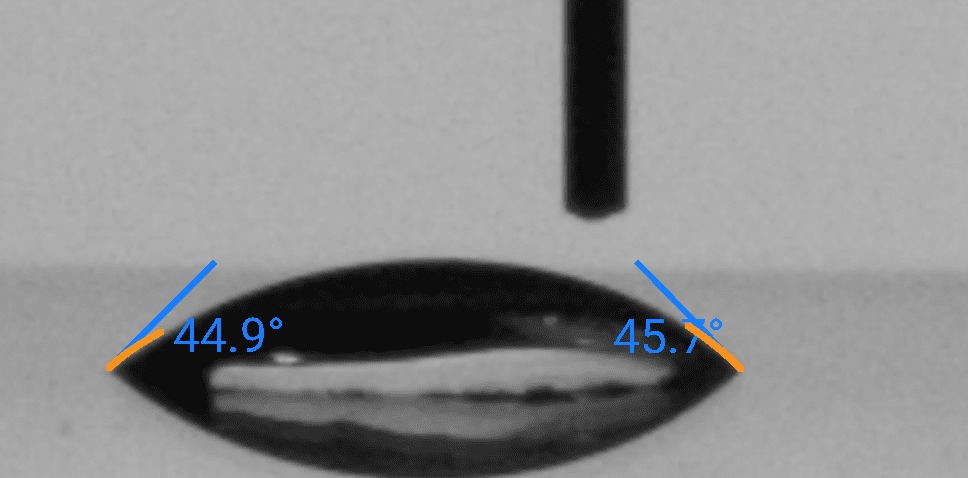
Dropometer water contact-angle measurement of DI water on Glass. This is the type of output used to rank candidates and decide which advances to field trials.
Sample Adjuvant Candidate Screening: Contact Angle and Retention Trade-off
| Candidate | Surface Tension (mN/m) | Water Contact Angle (°) | Drift-Reduction Potential | Coverage Assurance | Recommendation |
|---|---|---|---|---|---|
| Incumbent formulation (baseline) | 52 | 45° | Baseline drift profile | Good | Baseline benchmark |
| Candidate A (surfactant-based, 0.5%) | 38 | 62° | Excellent (larger droplets) | Marginal (higher contact angle) | Strong drift reduction risk of poor coverage |
| Candidate B (silicone-based, 0.3%) | 35 | 38° | Excellent (larger droplets) | Excellent (low contact angle) | Best balance; best drift-reduction candidate |
| Candidate C (organosilicone blend, 0.4%) | 44 | 48° | Good (modest droplet increase) | Good | Compromise candidate; adequate drift reduction with good coverage |
The incumbent formulation sets the baseline surface tension and wetting. Candidate A achieves the lowest surface tension (best drift reduction potential) but raises contact angle substantially, indicating potential coverage risk. Candidate B balances both properties best: low surface tension for drift reduction, low contact angle for coverage assurance—this is the recommended advancement to field spray-drift trials. Candidate C offers a middle ground: modest drift reduction with good coverage, suitable if field conditions are less wind-prone. This ranking exemplifies the drift-mitigation trade-off: no single candidate optimizes both drift reduction and coverage equally; the right choice depends on your field wind risk and coverage requirements.
Dépannage
Spray-drift-mitigation troubleshooting guide
Start condition: drift-reducing adjuvant performance is inconsistent, field drift is not reduced adequately, or coverage is poorer than expected. Use the signal pattern to identify the most likely cause.
Signal A
Surface tension is higher than target, or shows batch-to-batch variance
Likely cause: Supplier batch variability, adjuvant degradation during storage, or concentration drift in your formulation batch.
Action: Measure surface tension of a fresh adjuvant batch and a retained sample from the field batch. If new batch is lower, supplier issue. If formulation batch surface tension drifted, investigate concentration or mixing process.
Signal B
Surface tension is low, but field drift reduction is inadequate
Likely cause: Spray-equipment mismatch—nozzle or operating pressure incompatible with the formulation's droplet-formation behavior; or actual droplet-size distribution doesn't match surface-tension prediction.
Action: Verify spray-nozzle type and pressure are correct for your drift-reducing formulation. Conduct a nozzle-performance test (laser diffraction, if available) to confirm droplet-size distribution aligns with surface-tension reduction.
Signal C
Surface tension is low, but field coverage is poor
Likely cause: Contact angle is too high—the low-surface-tension adjuvant doesn't enable adequate wetting on your target leaf species.
Action: Measure contact angle on your target leaf species and conditions. If contact angle is >60°, reformulate to lower it (e.g., add a co-surfactant, or switch to an adjuvant with better wetting properties). Re-measure both surface tension and contact angle.
Signal D
Drift-reducing adjuvant performs well in lab but loses performance in storage or field conditions
Likely cause: Surface-tension control or adjuvant stability degradation due to storage temperature, light exposure, or incompatibility with other tank-mix components.
Action: Measure surface tension at release and after storage intervals to detect degradation trends. Verify storage conditions (temperature, light, container type). Test tank-mix compatibility with your pesticide active and water quality.
FAQ
Common questions before adoption
Lower surface tension is the chemical mechanism that enables larger, less-drift-prone droplets. But field drift also depends on spray-equipment performance (nozzle type, operating pressure), spray pattern, atmospheric conditions, and application timing. Use surface-tension measurement as an upstream formulation-development gate; validate with field spray-drift trials on your actual equipment and in realistic wind conditions.
No. An adjuvant that lowers surface tension to enable larger droplets but raises contact angle significantly will reduce drift but sacrifice coverage. You must measure and balance both properties. Candidates that minimize both surface tension AND contact angle are rare and most valuable.
Surface-tension measurement is a thermodynamic property; actual droplet size also depends on spray-nozzle orifice size, operating pressure, and fluid flow dynamics. Use surface-tension data as a directional R&D gate, then verify actual droplet-size distribution with nozzle-performance testing (laser diffraction or comparable method) on your equipment.
This is a formulation-development and QC gate for surface-chemistry consistency, not a final acceptance test for drift reduction. Confirm drift-reduction performance with field spray-drift trials on your equipment under realistic wind conditions. Surface-tension measurement is one upstream component of a drift-mitigation program, not the whole program.
Set a schedule based on your supplier's reliability. At minimum, measure every incoming lot; if your supplier is stable, you might reduce to every Nth lot after a qualification period. Use incoming-QC data to build a control chart; flag trends that suggest supplier drift in surface-tension control.
Measure surface tension at release, after storage intervals, and after temperature cycling to detect degradation. If degradation is detected, investigate adjuvant stability (active-ingredient type, buffer pH, antioxidants), storage conditions (temperature, light, container), and tank-mix compatibility. Some adjuvants are sensitive to specific conditions; qualification should include stability testing.
That depends on your spray-equipment nozzle type, operating pressure, target droplet size, and leaf species. No universal threshold applies. Start with your nozzle manufacturer's recommendations for drift-reducing adjuvants, measure surface tension of those products, then use that range as your development target and validation baseline.
Business Impact
What Changes When You Optimize Drift-Reducing Adjuvants Before Field Trials, Not After
Spray-drift formulation outcomes: before and with Dropometer
| Metric | Before Dropometer | With Dropometer | Indicative Benchmark |
|---|---|---|---|
| Adjuvant candidate selection | Trial-and-error field tests on all candidates | Surface-tension and contact-angle screening; 25–40% fewer field trials | "Objective surface-chemistry ranking vs. trial-and-error spray trials" |
| Field spray-drift trial success rate | 1–2 candidates succeed per 5–10 trials (low odds) | 3–4 candidates succeed per 3–5 trials (better odds due to pre-screening) | "Upstream chemistry screening improves field-trial success rate" |
| Time to deploy drift-reducing formulation | 18–24 months (multiple failed field trials) | 12–18 months (fewer candidates, faster iteration) | "Faster time-to-market via upstream optimization" |
| R&D adjuvant and formulation waste | $10,000–$15,000 per development cycle (discarded failed field candidates) | $3,000–$5,000 (screened candidates eliminated before field scale) | "Reduced material waste and development cost" |
| Incoming-QC consistency on surface-tension control | Accepted on supplier claim alone; batch variability unknown | Verified with numeric surface-tension gates; off-spec batches caught at incoming inspection | "Prevents field drift failures due to supplier batch drift" |
| Regulatory/environmental compliance substantiation | Anecdotal drift-reduction claims or absent documentation | Numeric surface-tension records paired explicitly with field spray-drift trial results | "Supports defensible documentation for EPA or state drift-reduction mandates" |
Instant ROI Snapshot
Spray-Drift Adjuvant R&D ROI Snapshot
Estimate saved field trials and development cost.
Each Dropometer unit is $5,000 — default assumes 1 unit.
Typical drift-reduction R&D: 8–15 candidates per development cycle, 1–2 cycles per year.
Adjuvant material, formulation prep, lab characterization per candidate.
Surface-tension, contact-angle, and retention measurements, data analysis.
Conservative: 30–40% of candidates screened out via surface-chemistry analysis, preventing costly field spray-drift trials.
Result
~0
Iterations saved / month
~0
Monthly savings
~0
Payback period
~0
Year-1 net benefit
Monthly savings = materials saved + technician time saved from reduced iterations.
Honest scope
What Surface-Chemistry Screening Cannot Tell You About Drift Reduction
Knowing the limits of any measurement tool is part of using it responsibly.
Surface tension and contact angle measure formulation chemistry. They do not predict actual in-field spray drift, which depends on spray equipment, nozzle type, operating pressure, wind speed, atmospheric stability, and application timing. Use surface-tension and contact-angle measurement as an upstream formulation-development gate; validate with field spray-drift trials.
Lower surface tension enables larger droplets in theory, but actual droplet-size distribution depends on spray-nozzle design and operating parameters. An adjuvant with low surface tension may not produce the expected droplet size if your nozzle type or pressure is incompatible. Always verify actual droplet-size performance with nozzle testing.
No universal surface-tension or contact-angle target applies across all spray systems, nozzle types, operating pressures, or leaf species. Calibrate your own thresholds against your equipment specifications, target droplet-size range, and field-performance baselines.
An adjuvant that shows excellent surface-tension control in the lab may still fail to reduce drift in the field if spray equipment is poorly maintained, nozzle wear changes droplet distribution, or wind conditions are extreme. Pair this chemistry screen with field spray-drift trials and equipment maintenance protocols.
Surface-tension stability during storage and under field conditions must be measured directly. Do not assume an adjuvant's laboratory surface tension predicts its performance after weeks in storage or in warm field conditions. Build stability testing into your qualification.
Batch-to-batch surface-tension consistency is only one aspect of adjuvant QC. Pair this screen with supplier audits, shelf-life validation, tank-mix compatibility testing, and other material specs to ensure full quality control.
Use this page to optimize drift-reducing adjuvant formulations and set incoming-QC surface-tension gates, not as a substitute for field spray-drift trials or for final drift-reduction performance claims. The Dropometer is one upstream layer in a spray-drift-mitigation program, not a replacement for the whole program.
Related use cases
Similar spray-formulation and adjuvant-optimization workflows
Improve Spray Droplet Coverage on Leaf Surfaces
A related adjuvant-optimization workflow focusing on wetting and leaf adhesion for coverage optimization, rather than drift reduction. Both use contact-angle measurement; this page emphasizes drift-specific surface-tension control.
CMC Assessment Techniques for Surfactant Concentration
A related formulation-screening workflow using surface-tension measurement to optimize surfactant critical micelle concentration for various applications.
Adhesive Bonding Surface Preparation
A related surface-readiness measurement workflow using contact-angle verification as a pre-bond gate; shares measurement methodology with drift-reduction adjuvant screening.
How this page was created
Editorial and technical transparency notes for this page.
Transparency Details
4 checklist items
01
Drafting assistance
Initial draft created with AI assistance (Claude 4.8 Opus Pro), then rewritten for technical clarity by Droplet Lab Staff
02
Transparency Note
Technical review and editing by a surface-science specialist for accuracy
03
Transparency Note
Identifiers, units, thresholds, and key claims checked against cited sources before publication
04
Transparency Note
Reviewed every 12 months or when underlying standards or instrument specifications change
Report a correction
Spotted an issue in this summary? Send a correction request and our team will review it.
Correction Request
We work hard to keep this standards summary accurate and up to date. If you spot an error (wrong revision/year, missing requirement, incorrect interpretation, or broken link), tell us and we'll review it.
Contact us to report a correction
Références
Sources
1.
EPA Spray Drift Mitigation Guidance. U.S. Environmental Protection Agency, Office of Pesticide Programs. https://www.epa.gov/pesticide-drift
2.
NACA Spray Drift Reduction Research. North American Crop Advisors Association. https://www.naca-usa.org/
3.
Chen et al. Contact angle measurement with a smartphone. Examen des instruments scientifiques, 89, 035117 (2018). https://doi.org/10.1063/1.5019979
4.
Fabrico. The Cost of Poor Quality (COPQ) in Manufacturing: 2026 Guide. https://www.fabrico.io/blog/cost-of-poor-quality-copq-manufacturing-guide/
5.
Making Strategy Happen. The Cost of Quality: The 1-10-100 Rule. https://www.makingstrategyhappen.com/the-cost-of-quality-the-1-10-100-rule/